Chinese Market in the Red Zone: Why Investors Traded Chips for Baijiu
На китайских биржах сегодня пасмурно: основные индексы Шанхая и Шэньчжэня просели более чем на 2%. В лидерах падения оказался сектор полупроводников и драгметал
AI-processed from 36Kr (36氪); edited by Hamidun News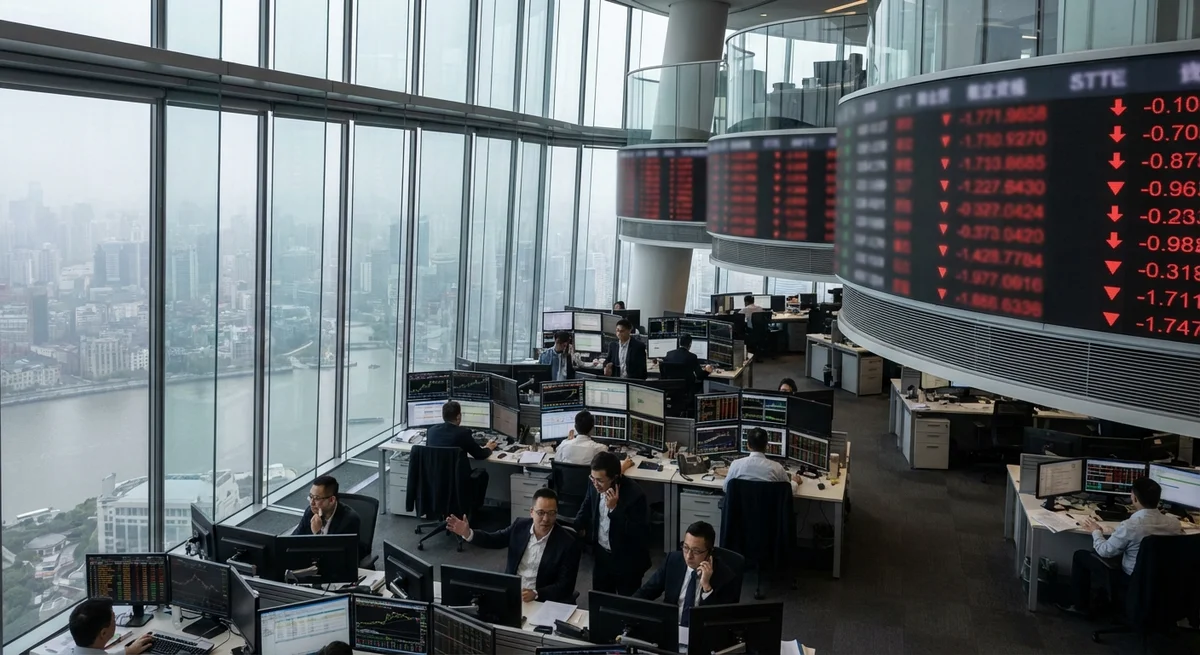
When the screens of monitors in Shanghai and Shenzhen light up with solid green (in China, this color symbolizes decline, unlike Western red), it is always reason for serious conversation. Today's trading session on the Class A (A) stock market was like a cold shower for those who believed in cloudless growth of the technology sector. Three key indices closed deeply in the red, losing roughly 2.
5% each. This is not merely a statistical margin of error, but a clear signal that investors' appetite for risk has temporarily dried up. Understanding the context of what is happening is crucial for grasping the global picture.
After several weeks of optimism fueled by expectations of state support, the market faced reality. The semiconductor sector, considered the backbone of Chinese technological independence, took the main blow today. Shares of Hua Hong, one of the largest contract chip manufacturers, plummeted more than 12%.
When such giants lose a tenth of their value in a day, it strikes the entire supply chain and makes even those holding positions for the long term nervous. Interestingly, gold and precious metals, traditionally considered a "safe haven," did not work today. Companies like CGE and Hunan Gold even hit their daily decline limit.
This suggests that investors are not simply shifting money from stocks to protective metals, but are massively moving into cash or seeking alternatives within the consumer sector. And here we see a typically Chinese paradox: when things are bad in high-tech, the market begins to believe in tradition. The baijiu sector, famous for Chinese strong liquor, unexpectedly showed growth against the general sentiment.
Shares of Huangtai Liquor soared to the daily limit, while Swellfun gained more than 7%. It seems investors decided that in unstable times, spirits production is a far more understandable and reliable business than complex lithographic processes. This is an ironic reminder that fundamental consumer habits often prove more resilient to crises than ambitious plans for chip import substitution.
Besides alcohol, the banking sector and road infrastructure showed modest gains. This is a classic "flight to quality" strategy and dividend stories. When innovative companies are battered, capital flows to where there are clear cash flows and state support in the form of banking systems.
For those following the AI and hardware market, this is an important lesson: even the most advanced industry is not immune to macroeconomic storms, and sometimes even chip manufacturers can envy the stability of distilleries. What does this mean for the industry in the near future? We will likely see a period of heightened volatility.
Chinese technology companies are now under double pressure: external restrictions on technology exports and internal market correction. However, such drops often create opportunities for "smart money" to enter cheapened assets. The question is only when panic will give way to rational calculation and belief that chips are after all more important than baijiu.
Key point: the market is shifting into tough defense mode, where traditional sectors are displacing high-tech. Will this become a prolonged trend or will we see a quick rebound in semiconductors?
Want to stop reading about AI and start using it?
AI News is a curated feed of AI/tech news. Hamidun Academy teaches you to use AI systematically in your work.