Nvidia and OpenAI: Jensen Huang Reminds Everyone Who Actually Calls the Shots
Слухи о том, что Nvidia готова влить в OpenAI астрономические 100 миллиардов долларов, оказались слегка преувеличены. Дженсен Хуанг расставил точки над i: никак
AI-processed from Bloomberg Tech; edited by Hamidun News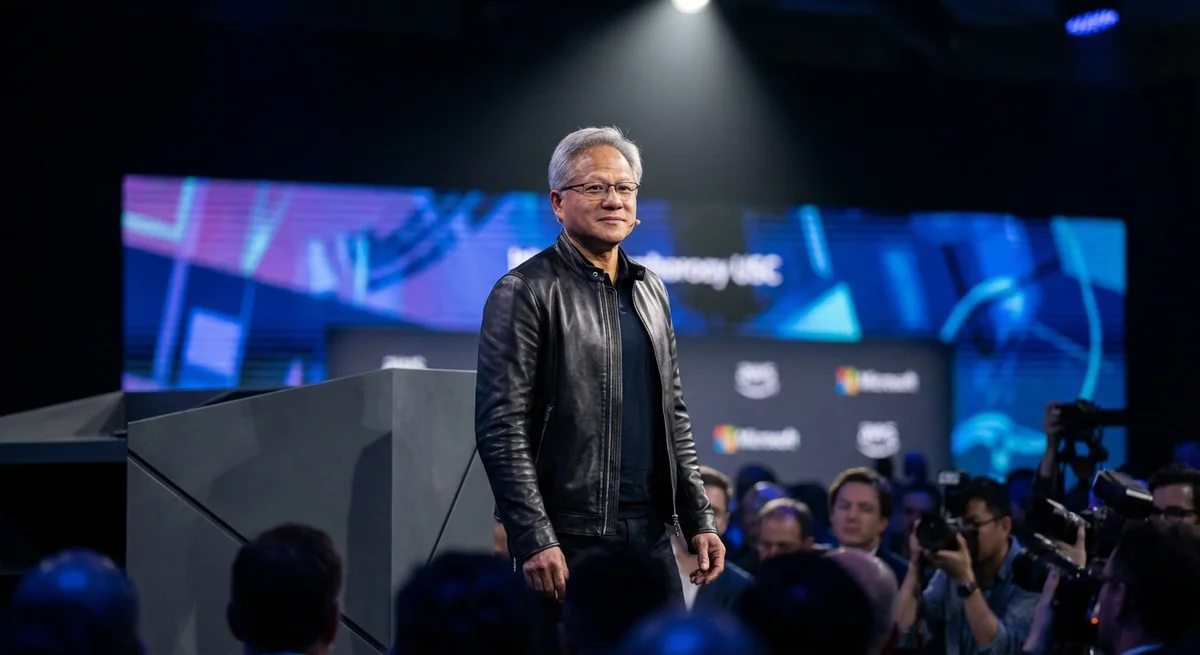
The investment saga around OpenAI has taken an unexpected turn that will force many to reconsider their forecasts for the coming couple of years. While the industry discussed the potential union of titans and an influx of an incredible 100 billion dollars, Nvidia's head Jensen Huang decided to bring everyone back to earth. His words that the company has no firm commitments to Sam Altman's brainchild sound like a cold shower for those who had already painted a picture of a cloudless future for OpenAI under the wing of the world's leading chip manufacturer. Huang emphasized that Nvidia will consider any financing rounds one by one, not making advance commitments for the future.
To understand why this statement is so important, one needs to recall the context of recent months. OpenAI is in a state of permanent search for money. Scaling models requires not just millions, but tens of billions of dollars — mainly for purchasing those very H100 and Blackwell accelerators that Nvidia produces. It would seem that for Nvidia to invest in OpenAI is like moving money from one pocket to another: you give them capital, they immediately return it to you by buying your hardware. But at this level of business, the logic of a closed loop doesn't always work, especially when the stakes are sums comparable to the budgets of small countries.
Huang emphasized that Nvidia considers each financing round separately. This is a classic position of strength. Why tie yourself down with long-term commitments to a company that, rumor has it, actively seeks ways to break free from Nvidia's grip and is developing its own processors? Project Tigris, which Sam Altman is promoting among investors, is a direct threat to Nvidia's dominance. Jensen, being an experienced strategist, understands perfectly: today OpenAI is his best customer, and tomorrow — a potential competitor in the silicon market. Supporting a competitor with money so they can later abandon your services looks like a questionable strategy.
Moreover, Nvidia must maintain its status as neutral territory. If the company gets too close to OpenAI, it will raise questions from other giants — Google, Amazon, and Meta, who are also spending billions on Nvidia chips. It's more profitable for Huang to sell tools to all participants in the gold rush, without showing obvious preference to anyone. Distancing from OpenAI is a clear signal to the market: Nvidia is not going to become a hostage to the ambitions of a single laboratory, even if that laboratory launched the current generative AI boom. It's also a way to avoid unnecessary attention from antitrust regulators, who are already closely monitoring Nvidia's every move.
For OpenAI itself, this statement is an alarming bell. If the chief beneficiary of the AI revolution is not ready to guarantee support, it means the risks of the project are rated higher than they appear from the outside. Perhaps the concerns are not only about the profitability of future models, but also about OpenAI's corporate structure, which lately resembles a patchwork of commercial and non-commercial interests. While Microsoft remains the main partner, OpenAI feels relatively safe, but dependence on investors' whims and lack of guarantees from the hardware supplier makes their position more vulnerable.
Ultimately, we are witnessing a big poker game. Huang simply reminded everyone that in this room only he holds all the trump cards. He doesn't need to invest 100 billion to control the market; it's enough for him to simply deliver orders on time to those willing to pay here and now. And OpenAI will have to prove its value in each new round, like any other startup, albeit the most expensive one in the world. The era of unconditional trust in promises of artificial general intelligence is gradually being replaced by pragmatic calculation and assessment of real profit.
The bottom line: Nvidia maintains neutrality and is not rushing to save OpenAI's budget without good reason. Will Altman be able to find 100 billion dollars without the involvement of the industry's main player?
Want to stop reading about AI and start using it?
AI News is a curated feed of AI/tech news. Hamidun Academy teaches you to use AI systematically in your work.