Suzhou: Chinese Robot Forge Grows by 5.4% and That's a Market Signal
If you think the future of AI is decided only in San Francisco offices, take a look at fresh figures from China. Suzhou — a city that many still perceive as…
AI-processed from 36Kr (36氪); edited by Hamidun News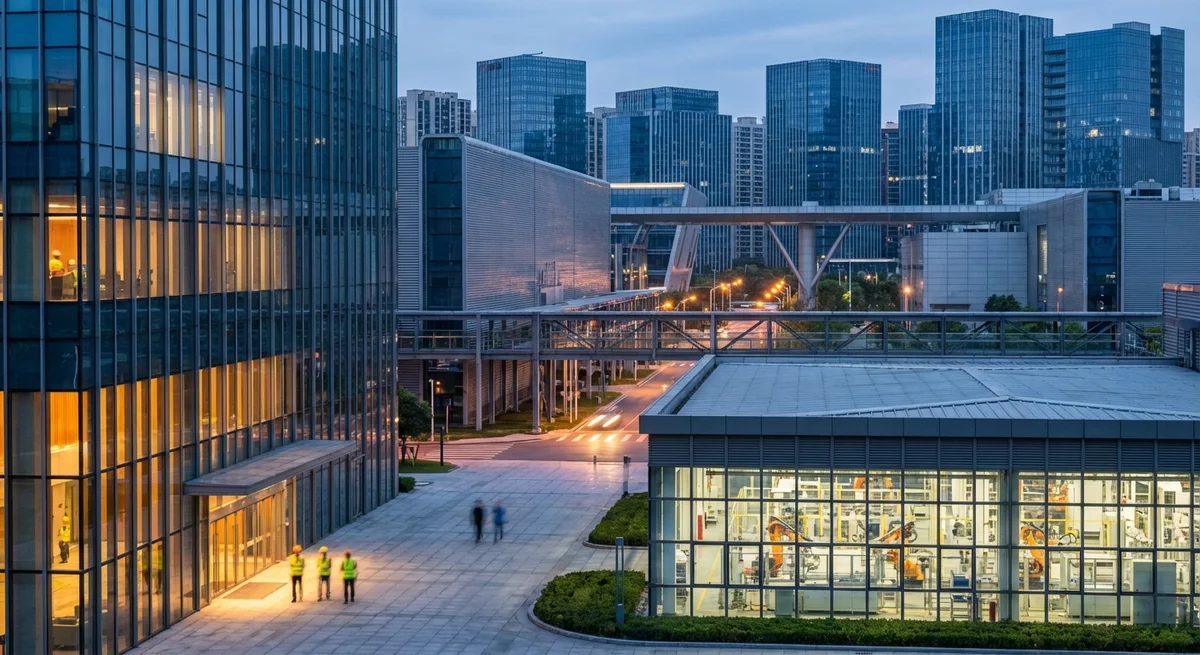
If you think the future of AI is decided only in San Francisco offices, take a look at fresh figures from China. Suzhou — a city that many still perceive as a tourist "Venice of the East" — has in fact become the main workshop of the global technological revolution. According to recent statistics, the city's GDP in 2025 exceeded 2.77 trillion yuan, showing confident growth of 5.4%. In a world where major economies celebrate even two percent growth, Suzhou demonstrates enviable dynamics. But the devil, as always, is in the details. Let's break down what stands behind these numbers.
The secondary sector, which includes industrial manufacturing and high-tech industries, showed the highest growth — 5.6%. This is exactly where ideas are transformed into silicon and steel. Suzhou stopped being a place of cheap sneaker assembly long ago. Today it is a cluster where lidars, high-precision sensors, and components for industrial robots are produced. When we talk about the successes of Chinese electric vehicle manufacturers or autonomous systems, we're essentially talking about the successes of Suzhou factories. The city methodically built an ecosystem in which R&D centers are located just a few kilometers from production lines. This gives iteration speed that the West can only dream about.
Why is this important right now? The AI industry is experiencing a transition from "pure reasoning" inside chatbots to embodied AI. Simply put, algorithms need a body — robots, drones, smart machines. The 5.6% growth in Suzhou's industrial sector directly indicates that demand for the hardware side of AI is only increasing. While software companies are burning billions on training models, Suzhou is earning these billions by supplying infrastructure. It's a classic strategy of "selling shovels during the gold rush," only instead of shovels here are photolithography equipment and servos.
The tertiary sector, including services and IT, grew 5.2%. This too is an important marker. The city is actively developing platforms for industrial Internet of Things and cloud services that serve those very factories. It turns out to be a closed loop: robots are manufactured on automated production lines controlled by local software. This makes the city's economy incredibly resilient to external shocks. Even if tomorrow access to foreign clouds is cut off, Suzhou will still have both factories and the software to run them.
Interestingly, agriculture grew 4.5%. Even here, technology wasn't absent: Suzhou is actively implementing agrobots and smart irrigation systems. This shows that modernization is advancing on all fronts, not just in narrow niches. The Chinese strategy of "new productive forces" is visible in action here. The city is not just scaling old manufacturing, it is replacing it with high-tech solutions that require fewer people but deliver more added value.
For the global market, this means one thing: dependence on Chinese "hardware" in the coming years will only intensify. You can relocate assembly to India or Vietnam as much as you want, but such a level of technological base as in Suzhou cannot be copied in a couple of years. It is a deeply integrated network of suppliers, engineers, and logisticians. If Suzhou is growing at such rates, it means the global automation flywheel is spinning faster and faster.
Ignoring these figures means not understanding what AI will run on tomorrow. The bottom line: Suzhou has finally consolidated its status as the hardware heart of the AI revolution. Will anyone in the world be able to offer an alternative to such a concentration of manufacturing power in the coming decade?
Want to stop reading about AI and start using it?
AI News is a curated feed of AI/tech news. Hamidun Academy teaches you to use AI systematically in your work.