AI Reveals the Secrets of Titan's Methane Clouds: A Breakthrough with NVIDIA
Space exploration has always been a challenging and time-consuming task, requiring enormous computational resources and time. However, thanks to developments…
AI-processed from NVIDIA AI Blog; edited by Hamidun News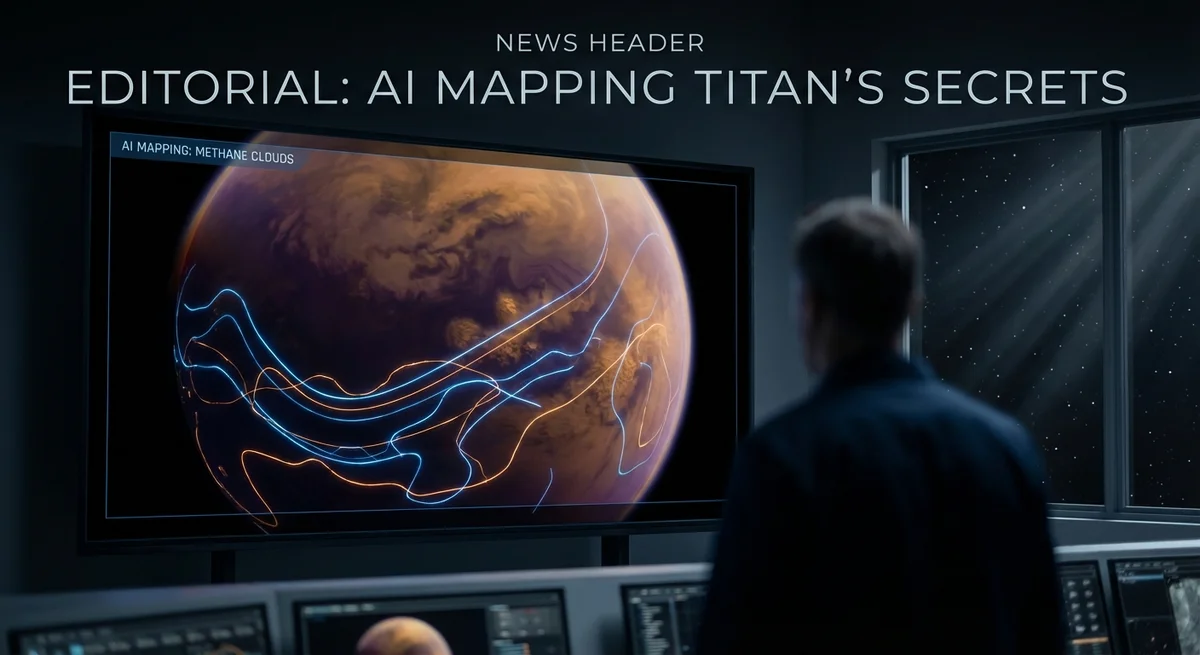
Space exploration has always been a challenging and time-consuming task, requiring enormous computational resources and time. However, thanks to developments in artificial intelligence and NVIDIA graphics processors, scientists can now solve problems that previously seemed impossible. A recent breakthrough in mapping Titan's methane clouds, a moon of Saturn, is a striking example. Using deep learning and powerful NVIDIA GPUs, researchers were able to analyze years of data collected by the Cassini spacecraft in just a few seconds, opening new horizons for understanding this mysterious world.
The Cassini-Huygens mission, a joint project of NASA, ESA, and ASI, was one of the most ambitious and successful projects in the history of space exploration. Cassini spent 13 years in orbit around Saturn, collecting invaluable data about the planet, its rings, and moons, including Titan. Titan is particularly interesting to scientists because it is the only known moon in the Solar System with a dense atmosphere and liquid lakes and seas on its surface. However, Titan's atmosphere is rich in methane, which forms clouds and rain, making its study a complex task.
Traditional methods of analyzing Cassini data were slow and labor-intensive, requiring manual processing and interpretation. To speed up this process, a group of researchers developed a deep learning algorithm trained on data collected by Cassini. The algorithm was run on NVIDIA GPUs, which allowed significantly reducing processing time. The results proved striking: AI was able to map Titan's methane clouds in seconds, whereas previously it took months or even years.
This breakthrough has far-reaching implications for space exploration. First, it demonstrates the tremendous potential of AI and GPUs for processing and analyzing large volumes of data collected by spacecraft. Second, it opens new opportunities for studying Titan and other alien worlds. By knowing the distribution of methane clouds, scientists can better understand Titan's climate and geology, as well as search for signs of life.
Moreover, this approach can be applied to other areas of science where analysis of large data volumes is required, such as medicine, geology, and climatology. The use of AI and GPUs can significantly accelerate scientific discoveries and lead to new breakthroughs in various fields of knowledge. In conclusion, the development of AI for mapping Titan's methane clouds is an important step forward in space exploration. It demonstrates the power of AI and GPUs for solving complex scientific tasks and opens new possibilities for understanding the Universe. This breakthrough emphasizes the importance of investments in research and development in the fields of AI and space technology, which can lead to new discoveries and innovations that change our world.
Want to stop reading about AI and start using it?
AI News is a curated feed of AI/tech news. Hamidun Academy teaches you to use AI systematically in your work.