Exoskeletons Are Coming: China Moves Wearable Robots from Clinics to Mass Market
The dream of an Iron Man suit has long remained either in the movies or in very expensive rehabilitation centers for people with spinal injuries. But it…
AI-processed from 36Kr (36氪); edited by Hamidun News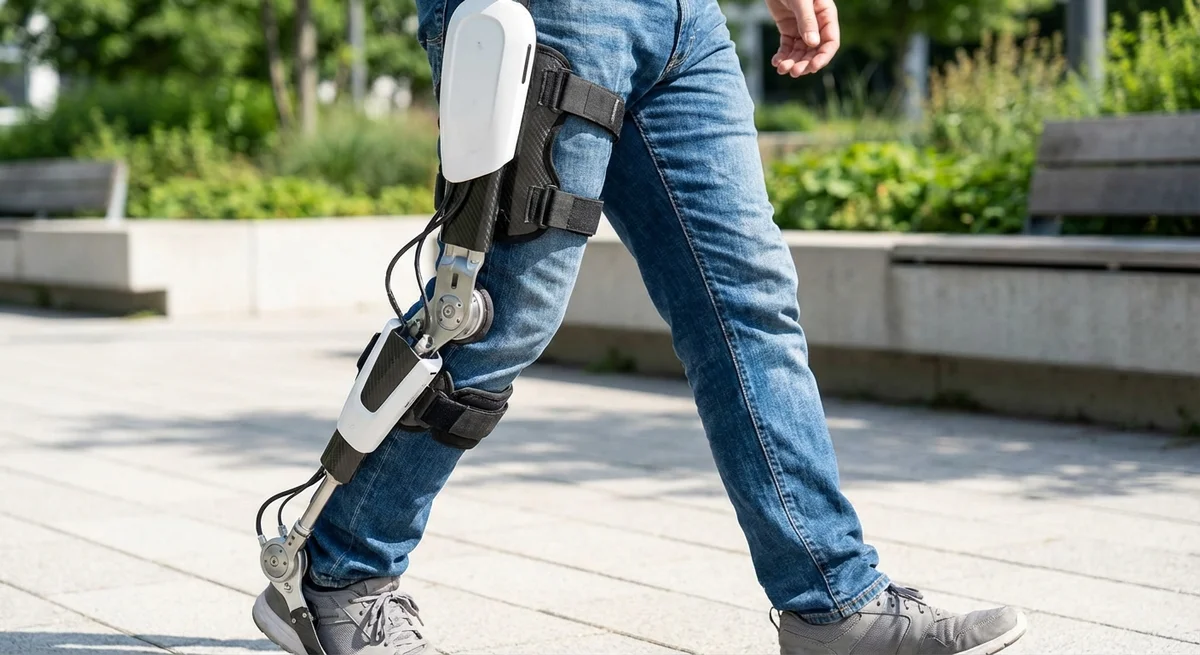
The dream of an Iron Man suit has long remained either in the movies or in very expensive rehabilitation centers for people with spinal injuries. But it seems we've reached the point where technology is finally hitting the streets. Analysts from Chinese agency CSC (Zhongxin Jian Tou/) released a report that directly states: the exoskeleton industry has entered a stage of accelerated commercialization.
This means that soon you'll be able to buy yourself "extra legs" to make hiking easier or simply carry heavy bags from the supermarket, and it won't cost as much as an airplane wing. Why is this happening right now? It's all about a fortunate combination of three factors: government support, technological maturity, and market readiness to pay.
In China, robotics has become a national priority, and it has paid off. If exoskeletons used to be bulky and temperamental devices, today they are becoming lighter and smarter. An explosive growth in demand from the C-end sector (consumer market) is not far off, and the industry is preparing for mass production.
This is a fundamental shift from niche medical equipment to mass consumer electronics. Of particular interest is the "insides" of these devices. The growing popularity of wearable robots is pulling the entire market for high-tech components with it.
In particular, analysts predict an expansion of the market for frameless torque motors and spatial orientation sensors. These parts are the heart and vestibular system of any exoskeleton. The more compact and efficient the motors become, the less the device resembles a torture instrument from the past century and the more it looks like a lightweight sports accessory.
Chinese companies are here playing ahead of the curve, creating a closed production chain within the country. Until 2025, the main focus remained medical rehabilitation. Helping people recover after surgery or injury is noble, but the market there is limited.
Starting this year, the situation has changed dramatically. Leading players one after another began announcing consumer-class products. These are devices for elderly people who find it difficult to walk long distances, for warehouse workers who lift tons of cargo daily, and even for outdoor enthusiasts.
We are seeing how technology is "descending" to people, becoming an accessible tool to improve quality of life. What does this mean for us? First, competition between manufacturers will inevitably lead to price reductions.
Second, we are in for a new wave of debates about where human ends and machine begins. But if we set aside philosophy, exoskeletons solve a very concrete problem of an aging population and a deficit of physical strength. In conditions where the average age of the population is growing, such "helpers" are becoming not a luxury, but a necessity.
China is already betting on this, turning scientific developments into real business with enormous potential. The bottom line: Exoskeletons stop being medical equipment and become a gadget. Are you ready to put on a robot under your jeans?
Want to stop reading about AI and start using it?
AI News is a curated feed of AI/tech news. Hamidun Academy teaches you to use AI systematically in your work.