China's Chi-Next Against All Odds: Investors Shift Yuan to AI
The Chinese market today decided to show some character, and this character has a distinctly technological hue. While major indices like Shanghai slowly slip…
AI-processed from 36Kr (36氪); edited by Hamidun News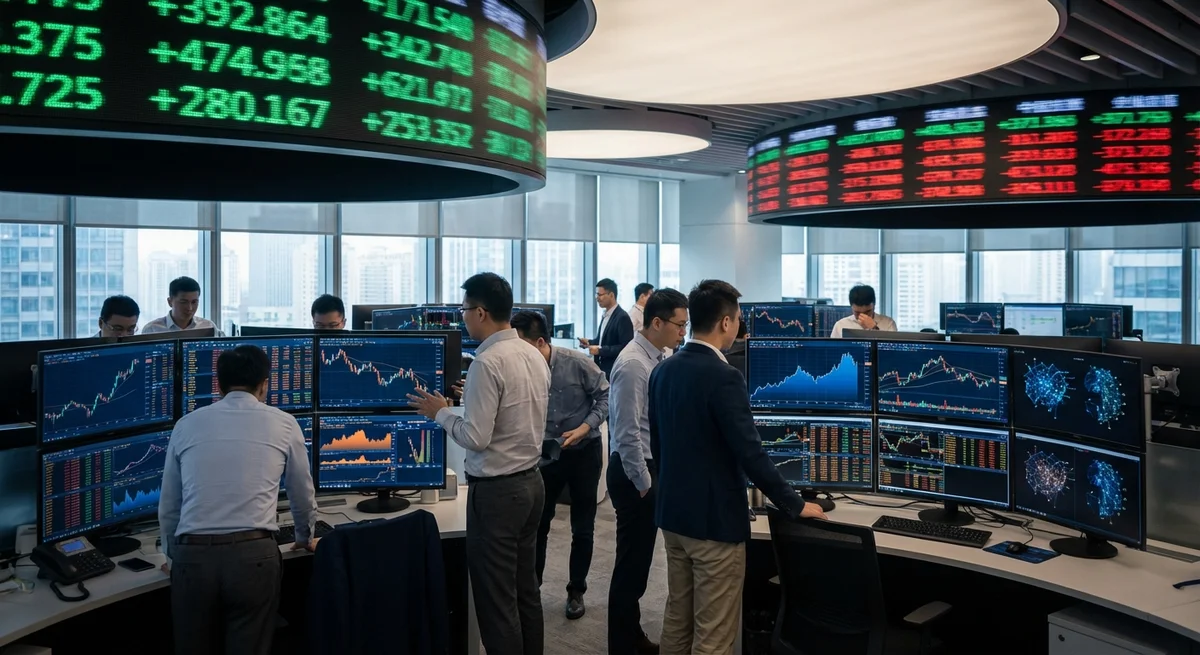
The Chinese market today decided to show some character, and this character has a distinctly technological hue. While major indices like Shanghai slowly slip downward, losing nearly a percent per session, the high-tech Chi-Next demonstrates confident growth of more than 1%. This is a classic story of how the old economy drags toward the bottom, while the new one tries to pull everyone up by their hair, like Baron Munchausen.
We're observing not just volatility, but a fundamental shift in priorities among those who control large amounts of money in the Middle Kingdom. For those who don't follow Chinese internal markets daily: the Chi-Next index is the local equivalent of Nasdaq. Here trade those who will shape the future of robotics, semiconductors, and, of course, artificial intelligence.
When this index grows against the grain of the broader market, it means one thing: investors no longer believe in concrete, steel, and endless construction. They're willing to take risks for algorithms and neural networks. Today, more than 1400 companies closed in the black, and most of them are representatives of the technology sector.
This is a broad rally, not a random spike of a couple of giants. Why is this happening right now? The answer lies in recent successes of Chinese developers of large language models.
Against the backdrop of US pressure and constant restrictions on chip supplies, Chinese companies have begun to show results that even make OpenAI nervous. China's internal market has fully realized that technological sovereignty is not just a pretty slogan from government newspapers, but the only way to survive in conditions of global competition. Capital is beginning to flow from traditional sectors into AI startups, creating the very impulse we see on the charts.
The Shanghai index fell 0.87%, and the Shenzhen index dropped 0.3%.
This decline reflects general fatigue from debt problems in the construction sector and uncertainty in global retail. However, technological optimism outweighs it. Investors are betting that Beijing will continue to inject liquidity into so-called new productive forces—a term that has recently become almost sacred in China.
This term implies an economy based on innovation, where AI occupies center stage. For the global AI community, this is an important signal. China is not going to slow down or admit defeat in the neural network arms race.
The growth in technology company valuations means access to cheap capital that will go toward training new models and attempts at equipment import substitution. While Western markets periodically discuss the possibility of an AI bubble, Chinese investors seem to have decided that this bubble is the only reliable life raft in their current economic ocean. We are witnessing the birth of a new reality where the technology sector lives in complete isolation from the problems of the real sector.
The main point: Investors in China have finally chosen their favorite. While traditional business stagnates, the AI sector gets a blank check and the money. Will technological optimism be able to drag the entire country's economy along with it, or are we seeing the formation of the largest bubble in the history of Chinese tech?
Want to stop reading about AI and start using it?
AI News is a curated feed of AI/tech news. Hamidun Academy teaches you to use AI systematically in your work.