Jensen Huang and OpenAI: When Investment Smells Like Monopoly
Nvidia официально в деле. Дженсен Хуанг в Тайбэе подтвердил, что компания вложится в новый раунд OpenAI. Это не просто жест доброй воли, а стратегический маневр
AI-processed from Bloomberg Tech; edited by Hamidun News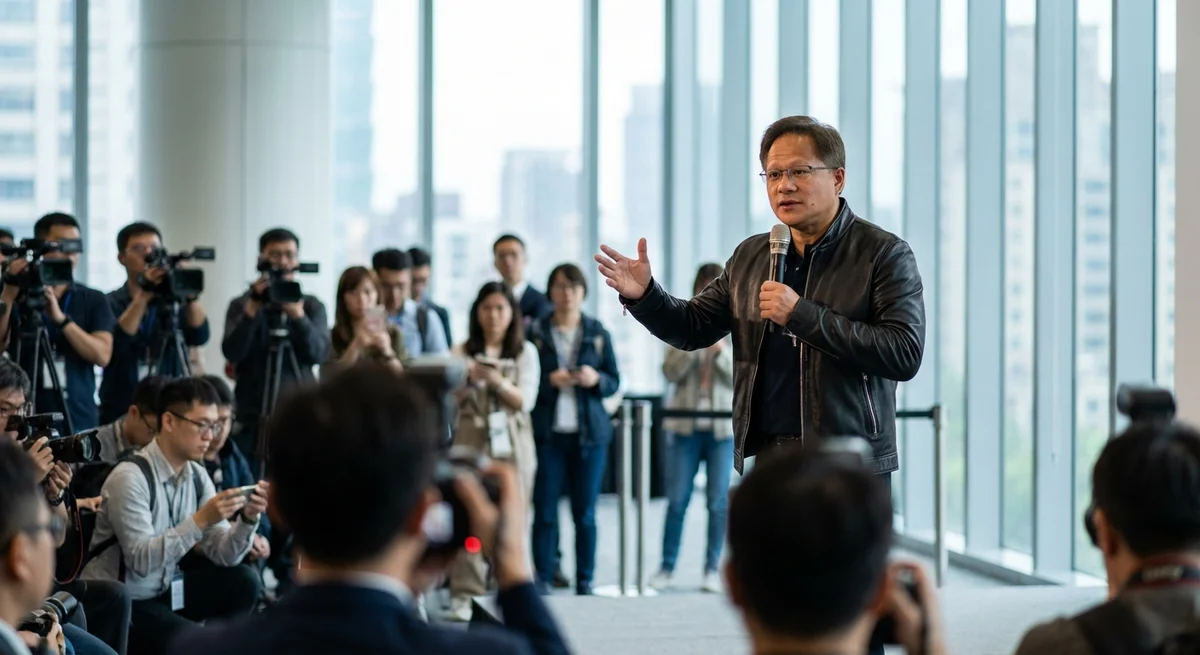
Jensen Huang rarely minces words, especially when it comes to money. At a recent press meeting in Taipei, the Nvidia CEO confirmed what the market has been whispering about for weeks: the "green giant" is officially participating in OpenAI's new funding round. Huang called it a "damn good investment," and in his mouth, this sounds not like bravado, but like a statement of fact. For context: OpenAI is currently trying to close a $6.5 billion round at a staggering $150 billion valuation. This is more than the market capitalization of most companies on the S&P 500, and Nvidia wants to secure its stake in this pie.
The history of relations between these two companies reads like a technology romance. In 2016, Huang himself personally delivered the first DGX-1 supercomputer to OpenAI's office when it was still a modest nonprofit startup. Much has changed since then, but the dependency remains. Today, OpenAI is the world's largest consumer of Nvidia chips. Every new iteration of GPT requires more computational power, which means more H100 accelerators and the upcoming Blackwell. By investing in OpenAI, Nvidia is effectively investing in its own sales division. It's an elegant, though questionable scheme: you give money to your client so they buy your products.
Why does Nvidia need this now? The answer lies in competitors' ambitions. Microsoft has already invested over $13 billion in Sam Altman, Apple is negotiating a stake, and Anthropic and Google are breathing down the neck. In this game of thrones, Nvidia cannot afford to remain merely a "shovel seller" during an AI gold rush. Direct equity participation gives Huang not only financial returns but also strategic influence over the roadmap of the planet's most influential neural network. If OpenAI decides to develop its own chips—rumors of this have circulated for a long time—having Nvidia as a shareholder could significantly dampen such ambitions.
However, behind the glitter of billion-dollar deals lurks a troubling trend. We are witnessing the formation of a closed ecosystem where a few giants control the entire tech stack: from silicon in chips to algorithms in chatbots. Regulators in the US and Europe are already giving suspicious looks to such "cross-pollination." When a hardware supplier becomes a co-owner of its main customer, questions arise about fair competition. What if smaller startups never get access to cutting-edge chips simply because they're not part of the "chosen investors' club"?
For OpenAI itself, this round is a matter of life and death. Despite enormous revenue, the company continues to burn through money at an alarming rate. Training next-generation models requires infrastructure worth tens of billions of dollars. Without support from Nvidia and other heavyweight partners, Sam Altman's ambitious plans to create AGI may crash against the harsh reality of liquidity shortage. In this sense, Jensen Huang acts not merely as an investor, but as a guarantor that the AI bubble—if it is a bubble—will continue to inflate for some time.
What does this mean for us? Most likely, we'll see even tighter integration of OpenAI's software and Nvidia's hardware. It's possible that future GPT models will be optimized for Blackwell architecture at such a deep level that running them on AMD or Intel chips becomes practically impossible. This creates a technological monopoly that will be extremely difficult to break. The AI market is definitively turning into a game for the ultra-wealthy, where the entry ticket costs billions, and the rules are set by those who hold the keys to the server rooms.
The main point: Nvidia is closing the loop, transforming from a supplier into a co-owner of the industry. Will anyone be able to break this bond, or are we already living in a world where the future of AI depends entirely on Jensen Huang's whims?
Want to stop reading about AI and start using it?
AI News is a curated feed of AI/tech news. Hamidun Academy teaches you to use AI systematically in your work.