SpaceX and a Million Satellites: Musk Builds an AI Cloud Straight in Space
Imagine you're looking at the night sky and realize that what's flying overhead isn't just a piece of metal broadcasting internet, but a working chip that's…
AI-processed from 36Kr (36氪); edited by Hamidun News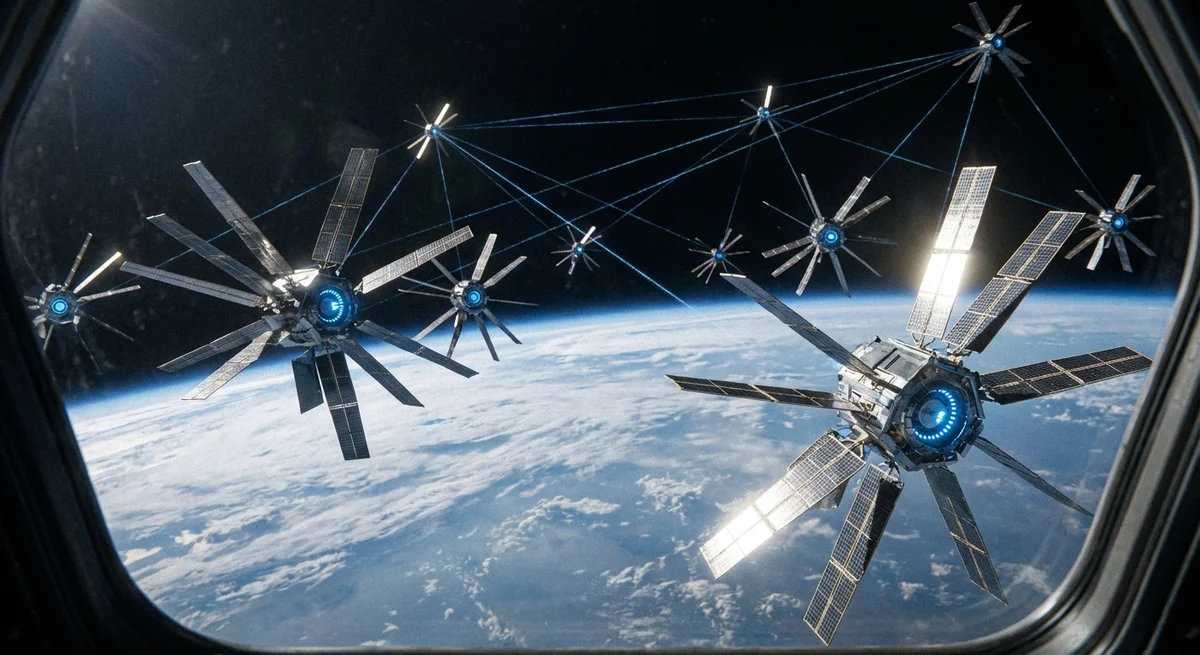
Imagine you're looking at the night sky and realize that what's flying overhead isn't just a piece of metal broadcasting internet, but a working chip that's processing someone's neural network request right now. SpaceX has just made a move that makes even the boldest predictions about Starlink's development pale in comparison. The company has filed an official application with the US Federal Communications Commission (FCC) to deploy a constellation of one million satellites.
This number seems like a typo, but the documents are deadly serious: this is about creating a global network of orbital data centers optimized for artificial intelligence tasks. Why does Musk need a million satellites when the current Starlink constellation has barely crossed six thousand? The answer lies in one word: inference.
Modern neural networks require colossal computing power not just for training, but for everyday operation. Today, your requests fly to enormous ground-based warehouses somewhere in Iowa or Finland. SpaceX proposes moving these computations to space.
The satellites will be positioned at altitudes ranging from 500 to 2000 kilometers in very narrow orbital layers just 50 kilometers wide. This will allow for maximum density of computing nodes while maintaining safe distance for maneuvers and avoiding collisions with other spacecraft. The technical side of this looks like science fiction turned reality.
The satellites will be powered by solar energy and communicate with each other through optical laser channels. This creates a unified high-speed network where data can move at the speed of light in a vacuum, which is 30-40% faster than in fiber optic cables on Earth. In essence, SpaceX is building a giant distributed supercomputer that envelops the planet.
Such an architecture will minimize latency for end users, as signals will be processed by the satellite nearest to them, rather than traveling a long path through terrestrial lines and routers. The context of this event cannot be ignored. We are in the midst of a "computational fever," when Nvidia can't ship chips fast enough and the power grids of states are buckling under the appetite of new data centers.
Moving computations to orbit solves two fundamental problems: cooling and space. In space, there's no shortage of area, and managing heat dissipation, though a complex engineering task in a vacuum, eliminates the need to spend millions of tons of water and gigawatts of electricity on air-conditioning ground facilities. Moreover, such a network becomes practically immune to local disasters or political upheaval on Earth.
Of course, the question is whether the FCC will allow the orbit to become one continuous server rack. A million objects is a colossal strain on the space debris monitoring system and astronomy. Astronomers are already complaining about the "light pollution" from Starlink, and a 150-fold increase in satellites could permanently blind us to optical observation of the stars.
Nevertheless, Musk has always acted on the principle of "do first, negotiate later." If this project is implemented even 10%, SpaceX will transform from a transportation and telecommunications company into the planet's main AI provider, controlling not only the communication channels but also the intelligence transmitted through them. The key point: SpaceX is moving from selling traffic to selling computing power, creating the first ever "cosmic brain."
Will competitors be able to offer anything comparable in scale, or will the orbit become the private property of one corporation?
Want to stop reading about AI and start using it?
AI News is a curated feed of AI/tech news. Hamidun Academy teaches you to use AI systematically in your work.