Kingsemi: a billion yuan to make Chinese chips stop breaking
Китайская Kingsemi решила, что пора играть по-крупному, и привлекает 970 миллионов юаней на расширение мощностей. Пока индустрия гонится за нанометрами, компани
AI-processed from 36Kr (36氪); edited by Hamidun News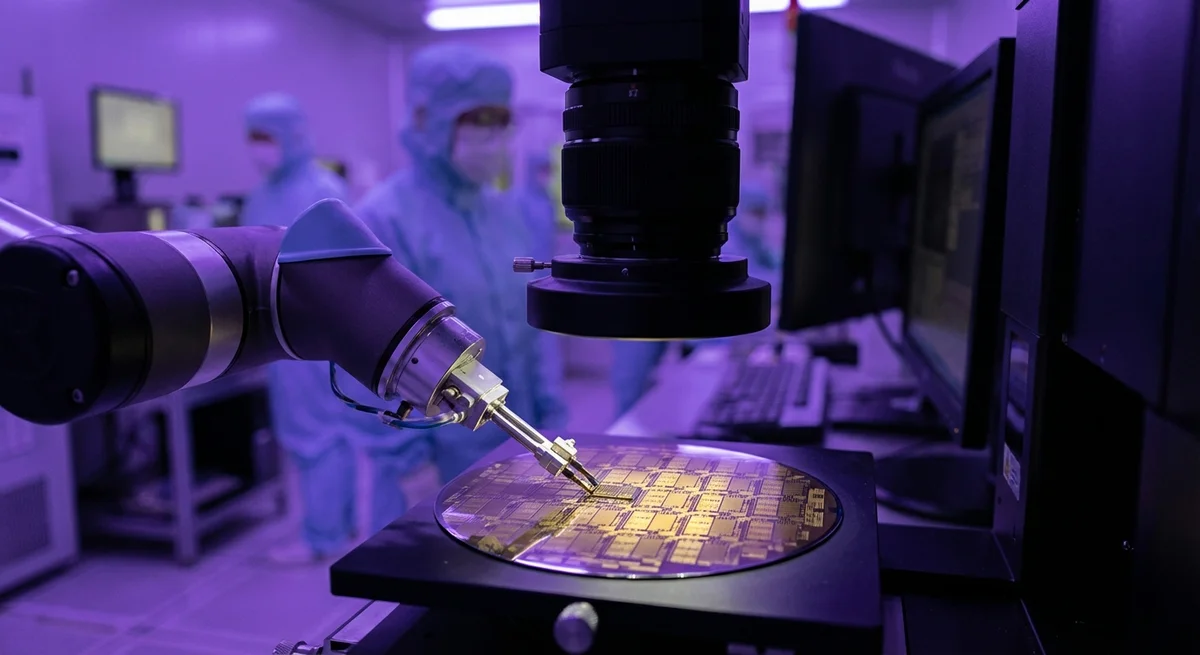
While the general public is mesmerized by how many teraflops the next Nvidia novelty will produce, professionals are looking at completely different things. In the semiconductor world, there is an "unsexy" side — testing and packaging. These are the very stages where it becomes clear whether an expensive silicon wafer will become the brain of a supercomputer or high-tech garbage.
Chinese company Kingsemi has decided that this is exactly where the most promising money is buried right now, and announced plans to raise 970 million yuan through a private placement of shares. Why do they need so much money? The answer lies in Beijing's ambitions to achieve complete technological independence.
The bulk of the funds will go to a project for testing integrated circuits in Dungcheng and launching the first phase of a project for laser hidden cutting of wafers. If you thought chips were simply cut with a jigsaw, I'm sorry to disappoint — it's an extremely complex process where the slightest error destroys thousands of dollars in profit. But the most interesting thing here is R&D in the field of advanced heterogeneous stacking processes.
In an era when Moore's Law began to stumble, it is precisely the packaging of multiple dies into a single package (chiplets) that becomes the only way to increase power for artificial intelligence tasks. Context is more important than the numbers themselves here. China is under colossal pressure from Western sanctions that limit access to advanced lithography equipment.
In this situation, the logic is simple: if we cannot make transistors infinitely small, we must learn to package what we have as efficiently as possible and test it so rigorously that the percentage of good crystal yields approaches perfection. Kingsemi is essentially taking on the role of one of the main quality controllers for the entire Chinese chip industry. It's also interesting how the company manages its resources.
Part of the attracted funds will go towards replenishing working capital and repaying bank loans. This is a classic maneuver: clean up the balance sheet so you have the ability to respond quickly to market changes. In the context of trade wars, flexibility is more important than simply having full warehouses.
Kingsemi understands that right now China is building dozens of chip manufacturing plants, and all of them will need testing and product finalization services. What does this mean for the market? We are seeing how the Chinese semiconductor ecosystem stops being a collection of disparate startups and turns into a monolithic structure.
Companies like Kingsemi create the infrastructure that will allow local GPU and CPU developers to feel more confident. If the Dungcheng project is implemented on schedule, this could significantly reduce the dependence of local customers on foreign testing hubs in Taiwan or Southeast Asia. The main point: Kingsemi is betting on the "logistics" of technological sovereignty.
Packaging and testing — this is a new front in the battle for AI supremacy. Will China be able to compensate for its lag in lithography through ingenious engineering packaging?
Want to stop reading about AI and start using it?
AI News is a curated feed of AI/tech news. Hamidun Academy teaches you to use AI systematically in your work.