AI in Science: Why Neural Networks Haven't Earned Their White Coat Yet
Индустрия AI для науки (AI4S) переживает кризис завышенных ожиданий. Пока AlphaFold предсказывает структуры белков, обычные LLM пасуют перед элементарными физич
AI-processed from Jiqizhixin (机器之心); edited by Hamidun News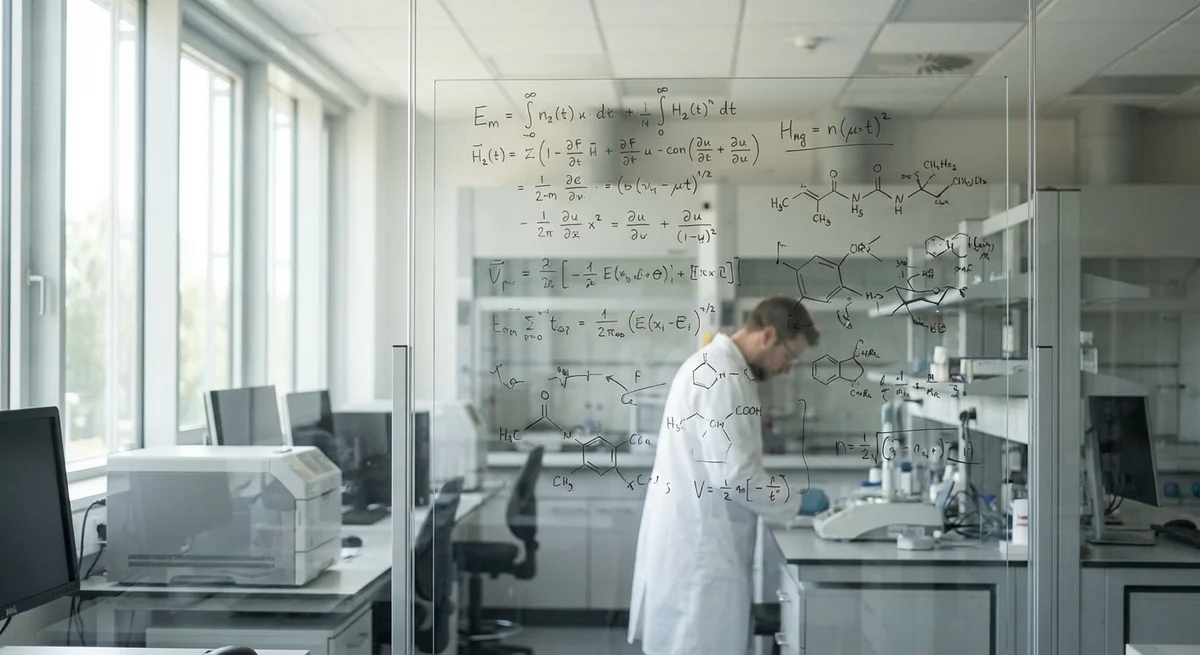
Listen, let's be honest: while we enthusiastically discuss how the next language model wrote code or composed poetry, things are far from rosy in actual laboratories. There's a trendy direction — AI for Science, or AI4S. It was supposed to overturn our understanding of chemistry, physics, and biology. But if you look closely, modern "smart" models are still infinitely far from being called full-fledged scientists. They're more like very well-read students who've memorized a library but panic when handed a test tube.
It all started with the first wave, now called AI4S 1.0. Google DeepMind's AlphaFold became the star here. It brilliantly tackled protein structure prediction, and that really was a breakthrough. But here's the catch: it was a victory of brute force and pattern recognition. The model found patterns in a massive dataset that humans had collected over decades. That's cool, but it's not quite science in the classical sense. Science isn't just finding coincidences — it's understanding why the world works this way and not another.
The main problem with current top models is that they live in a world of words and pixels, not atoms and forces. Scientists call this the absence of "first principles" understanding. When you ask AI to design a new material, it starts combining data it knows. But it doesn't feel the laws of thermodynamics or quantum mechanics the way a physicist does. As a result, we get hallucinations that look like scientific papers but crumble when you try to verify them in reality. Models simply can't reason within strict physical constraints.
Right now the industry is frantically searching for the path to AI4S 2.0. It's not just about "more data" or "more GPUs" anymore. It's about changing the fundamental architecture of machine thinking. We need what China calls "scientific intelligence" — systems with physical laws baked in from the start. Imagine a neural network that can't produce an answer violating the law of energy conservation simply because its mathematical structure doesn't allow it. This is a fundamental shift from probabilistic guessing to deductive reasoning.
Moreover, real science requires autonomy. We're moving toward the concept of "closed labs," where AI doesn't just advise but plans the experiment itself, controls robotic manipulators, and most importantly, corrects its theory based on obtained failures. Current LLMs hate being wrong — they try to please the user. A real scientist knows that a negative result is still a result. Until we teach AI to value mistakes and draw logical conclusions from them, it will remain just an expensive toy in researchers' hands.
There's also the data problem. To train GPT-4, they used almost the entire internet. But in science, data is scarce, fragmented, and often locked in corporate archives. For AI4S 2.0 to become reality, we need to teach models to learn from small samples and synthesize data through simulations. This is a huge challenge for engineers, and it's still unclear who will be the first to find this key. But one thing is clear: the next Nobel Prize involving AI won't be awarded for "beautiful text," but for understanding the very essence of matter.
Key point: Current AI is a brilliant librarian but a mediocre experimenter. Will the AI4S 2.0 concept transform neural networks into independent researchers, or will we hit a ceiling where machines are fundamentally incapable of intuitive breakthroughs?
Want to stop reading about AI and start using it?
AI News is a curated feed of AI/tech news. Hamidun Academy teaches you to use AI systematically in your work.