LingBot-VA: Ant Group Teaches Robots to Think, Not Just Mimic
While we debate whether ChatGPT will replace programmers, Ant Group's laboratories are solving a far more grounded, yet complex problem: how to prevent a…
AI-processed from Jiqizhixin (机器之心); edited by Hamidun News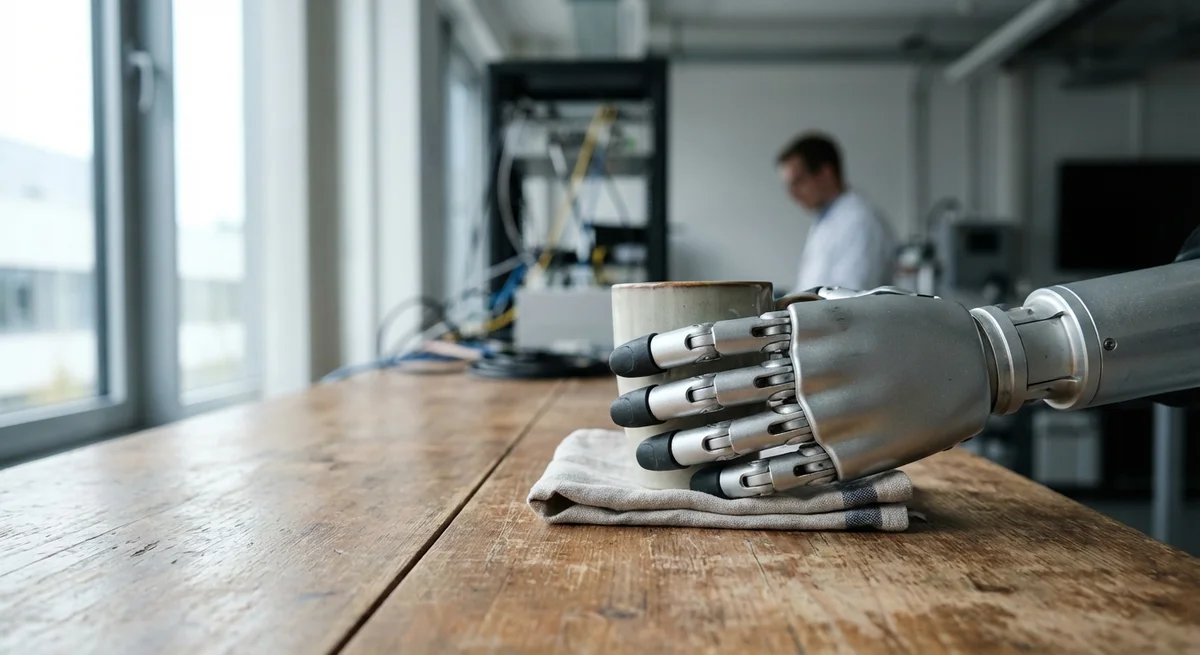
While we debate whether ChatGPT will replace programmers, Ant Group's laboratories are solving a far more grounded, yet complex problem: how to prevent a robot from crashing into a wall and carefully moving a cup. The new LingBot-VA model is not just another software update, but a serious bid for leadership in embodied intelligence. If robots were once trained like dogs — "copy me" — now they're being taught to think like physicists.
Progress here is measured not by text quality, but by a machine's ability to avoid breaking glass in unfamiliar surroundings. The problem with modern robots isn't hardware. Motors and servos have long enabled the construction of remarkable things, but the problem has always been in the "brains."
Most systems still rely on behavior cloning. A robot sees an image, recalls what a human did in a similar situation, and attempts to imitate the movement. But the moment lighting changes or an object shifts a couple of centimeters, the algorithm breaks.
LingBot-VA takes a different approach, using the concept of a world model. The robot literally calculates future scenarios in its virtual head before moving the manipulator. The numbers speak for themselves.
Developers claim that in complex scenarios — where you need not just to grasp, but to demonstrate some ingenuity in space — LingBot-VA shows results 20% higher than the known Pi0.5 model. This is a colossal gap for an industry where the battle usually comes down to fractions of a percent.
Ant Group managed to unite visual perception with deep understanding of physical interactions. For us, this means the era of robot vacuums helplessly stuck on carpets is gradually ending, giving way to systems capable of navigating the chaos of an ordinary human apartment. Special attention deserves the decision to make LingBot-VA an open project.
There's now a clear divide in the AI world. On one side we see closed ecosystems like OpenAI, jealously guarding their weights and architectures. On the other — open-source advocates believing true progress is impossible alone.
By releasing LingBot-VA to free access, Chinese engineers essentially invite the global community to fine-tune their model. This is a classic strategic move: become the foundation for hundreds of startups and turn your technology into an industrial standard while competitors try to monetize closed access. Why does this matter right now?
We're on the brink of a humanoid robot boom. Tesla, Figure, and Boston Dynamics are competing in whose creation looks more human and moves more smoothly. But appearance is secondary.
Without an adequate world model, any humanoid remains just a very expensive and dangerous toy. LingBot-VA closes the gap between theory and practice, giving machines understanding of cause-and-effect relationships. Chinese AI school once again proves it can not only quickly copy but also set the pace in the most complex disciplines.
The question remains: how quickly will Western laboratories present their answer, and will it be as accessible to independent developers? Main point: Open-source in robotics is becoming a new force. While giants build walls, Ant Group gives away the blueprints for robots' brains of the future.
Are we ready for the next breakthrough in AI to come not from Silicon Valley, but from Hangzhou?
Want to stop reading about AI and start using it?
AI News is a curated feed of AI/tech news. Hamidun Academy teaches you to use AI systematically in your work.