AI Against Breast Cancer: Down 12% in Late-Stage Diagnoses
В Швеции завершилось крупнейшее исследование роли ИИ в маммографии с участием 100 тысяч женщин. Результаты впечатляют: использование нейросетей позволило сократ
AI-processed from Guardian; edited by Hamidun News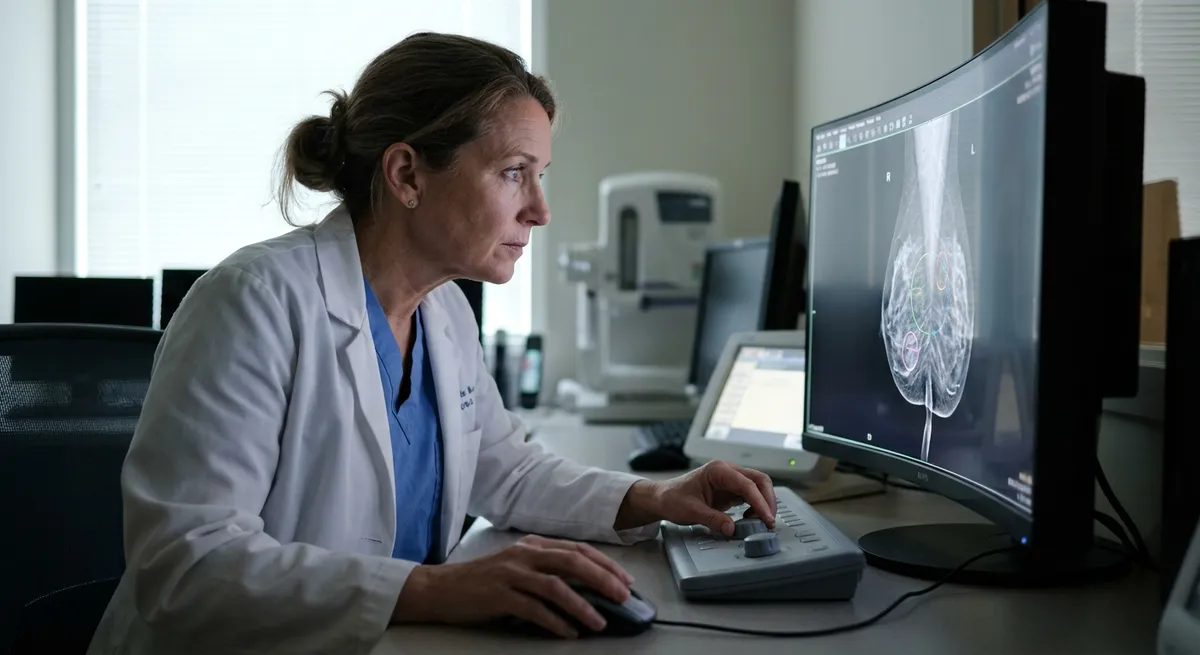
While we debate whether ChatGPT will replace programmers, AI is already saving lives in Swedish clinics, doing so with a precision unavailable to humans. Let's be honest: a radiologist's job is an endless stream of gray images where you must find a tiny deviation that could cost a person their life. Eyes grow weary, attention wanes, and the price of error is astronomical. This is why Europe has adopted the "double reading" standard, where one image is reviewed by two independent specialists. Yet even this system fails, not to mention the catastrophic shortage of personnel in the industry.
Swedish researchers decided to test whether an algorithm could become that ideal partner who never gets tired and doesn't drink coffee. The experiment involved 100,000 women. This is not just a sample; it's the largest trial of its kind in history. Half the images were reviewed the old-fashioned way by two doctors, the other half by one doctor with AI support. Results published recently force us to reconsider our attitude toward digital diagnosticians. It turned out that using AI reduces the frequency of cancer detection between screening intervals by 12%. These are the very cases where during an examination a doctor says everything is fine, yet a year later the patient returns with an advanced tumor.
Why does this happen? The human brain tends to ignore anomalies that don't fit the typical pattern, or simply misses microscopic changes due to fatigue. The neural network, however, is trained on millions of images and searches for patterns in pixels that look like ordinary noise to us. During the study, the group with AI support showed a significantly higher rate of early detection. This means the disease was caught when chances of complete recovery were close to one hundred percent, and treatment would be much less aggressive.
It's important to understand the context: this study is not about robots pushing doctors out in the cold. On the contrary, it's a story about efficient resource allocation. Right now, the healthcare industry worldwide is groaning under a shortage of experienced radiologists. If AI takes on the role of a "second pilot" or acts as an initial filter for obviously clear images, doctors will be able to spend more time on complex, disputed cases. This is not a replacement for intelligence, but its multiplicative amplification. The Swedes proved that this model is not merely viable; it's safer for the patient.
Of course, questions of ethics and responsibility remain. Who is responsible if AI makes a mistake? How do we avoid algorithmic bias? But numbers are stubborn things. 12% means thousands of saved women who won't hear a terrifying diagnosis too late. We're entering an era where "the machine's opinion" becomes more important than a council of professors, and this seems to be the best application of technology imaginable. While Silicon Valley generates pictures of cats, medicine quietly conducts a silent revolution, where the grand prize is our longevity.
The bottom line: AI has proven its effectiveness in the hardest task—finding hidden threats that professionals miss. Are we expecting widespread adoption of "doctor + algorithm" protocols in the coming couple of years?
Want to stop reading about AI and start using it?
AI News is a curated feed of AI/tech news. Hamidun Academy teaches you to use AI systematically in your work.