War of Machines: Why Soldiers Started Surrendering to Robots
На фронте зафиксирован исторический прецедент: группа солдат сдалась в плен наземному роботу с пулеметом. Это не сцена из фантастического фильма, а новая реальн
AI-processed from Futurism; edited by Hamidun News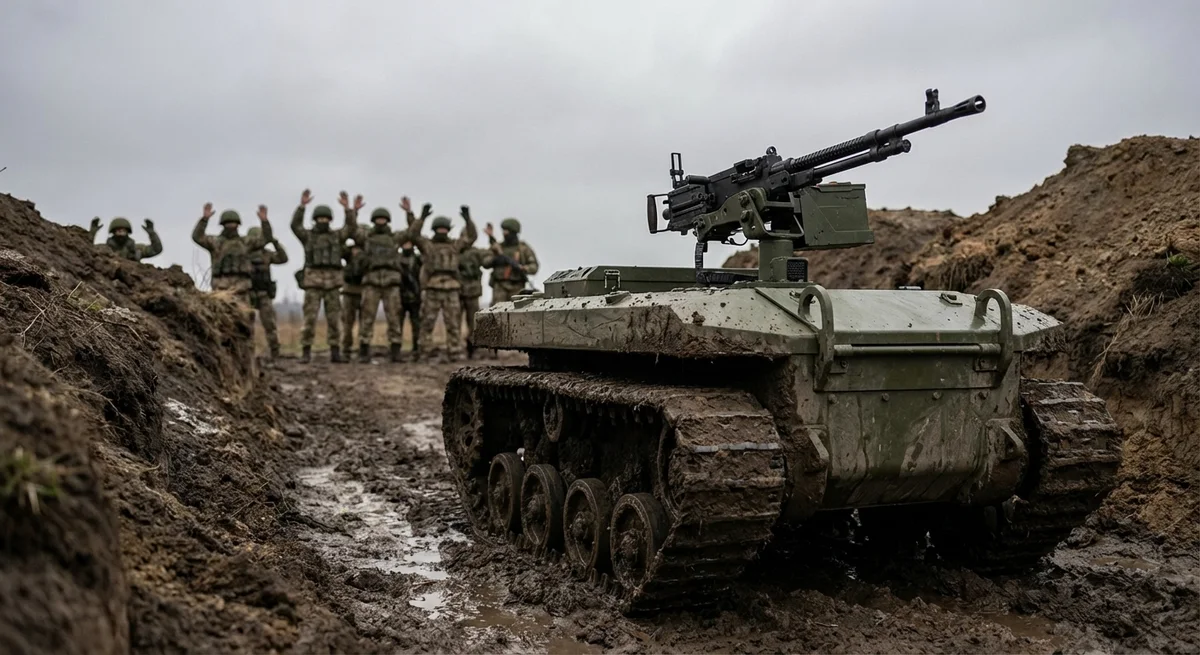
Remember those old footage from Operation Desert Storm, when Iraqi soldiers tried to surrender to a Pioneer reconnaissance drone? Back then, it seemed like a curiosity, a technological anomaly. But in 2024, the jokes have ended. Footage has appeared online showing soldiers raising their hands before a tracked platform equipped with a turret and a machine gun. This is not simply an episode of a local skirmish; this is the moment when the concept of warfare has officially entered a new, terrifying phase. We are accustomed to videos of FPV drones, which have become commonplace, but a ground robot dictating the terms of surrender is an entirely different level of psychological impact.
Why is this happening right now? The answer lies in the sharp drop in the cost of computer vision technologies and stabilization systems. What once cost hundreds of thousands of dollars and was accessible only to laboratories like Boston Dynamics is now being assembled in garages from components designed for civilian drones.
Unmanned ground vehicles (UGVs) have become reliable enough to traverse difficult terrain and carry serious weaponry. But the main change has not occurred in the hardware, but in people's minds. Soldiers on the front lines understand: you cannot negotiate with a robot.
It has no fear, no fatigue, and, most importantly, no doubts. When a steel box is moving towards you, one that sees you in thermal vision and is ready to open fire at the slightest movement, self-preservation instinct dictates the only correct decision.
This incident exposes a massive gap in international law. The Geneva Conventions were written by people for people. They embody principles of humane treatment that presume empathy on both sides.
How should a robot ensure the rights of prisoners of war? How should it escort them without violating security protocols? For now, it looks like improvisation on the spot: the operator sees raised hands through the camera and probably issues commands through a loudspeaker.
But what happens when the connection with the operator is lost? Modern systems are increasingly equipped with autonomous return functions or "free hunt" modes. Is the algorithm ready to recognize a gesture of surrender as a command to cease fire, or will it interpret this as suspicious activity?
For the AI industry, this is a serious challenge. We have spent years discussing the ethics of "lethal autonomous weapons systems" (LAWS) in comfortable UN halls while battlefield reality has outpaced any bureaucratic regulations. The gap between technological progress and legislation has become critical. If we once feared that robots would kill indiscriminately, we now face a situation where they are managing human behavior through fear of their "soullessness." This is the absolute dehumanization of conflict, where the person on one side of the screen becomes a gamer, and the person in front of the drone's camera becomes a target, deprived of the right to human dialogue.
In the coming years, we will see the mass emergence of such platforms. They will become smarter, more autonomous, and cheaper. This means that the presence of a human in the "red zone" will become not just dangerous, but pointless. We are entering an era when the outcome of battles will be decided not by courage or the tactical genius of commanders, but by code quality and battery capacity. And if today soldiers surrender to robots, tomorrow robots may begin making decisions about the feasibility of taking prisoners in principle. This is not a scenario for a dystopia, but a logical development of the current technological trajectory.
The bottom line: The psychological barrier has fallen — humans have recognized machine dominance on the battlefield. Are we ready for the legal consequences of a world where the right to life and death is delegated to an algorithm?
Want to stop reading about AI and start using it?
AI News is a curated feed of AI/tech news. Hamidun Academy teaches you to use AI systematically in your work.