Apple Learns to Read Lips: Why Cupertino Needs the Israeli Startup Q.ai
Apple поглотила израильский стартап Q.ai, специализирующийся на анализе движений лица и невербальной коммуникации. Это приобретение ложится в общую канву страте
AI-processed from Bloomberg Tech; edited by Hamidun News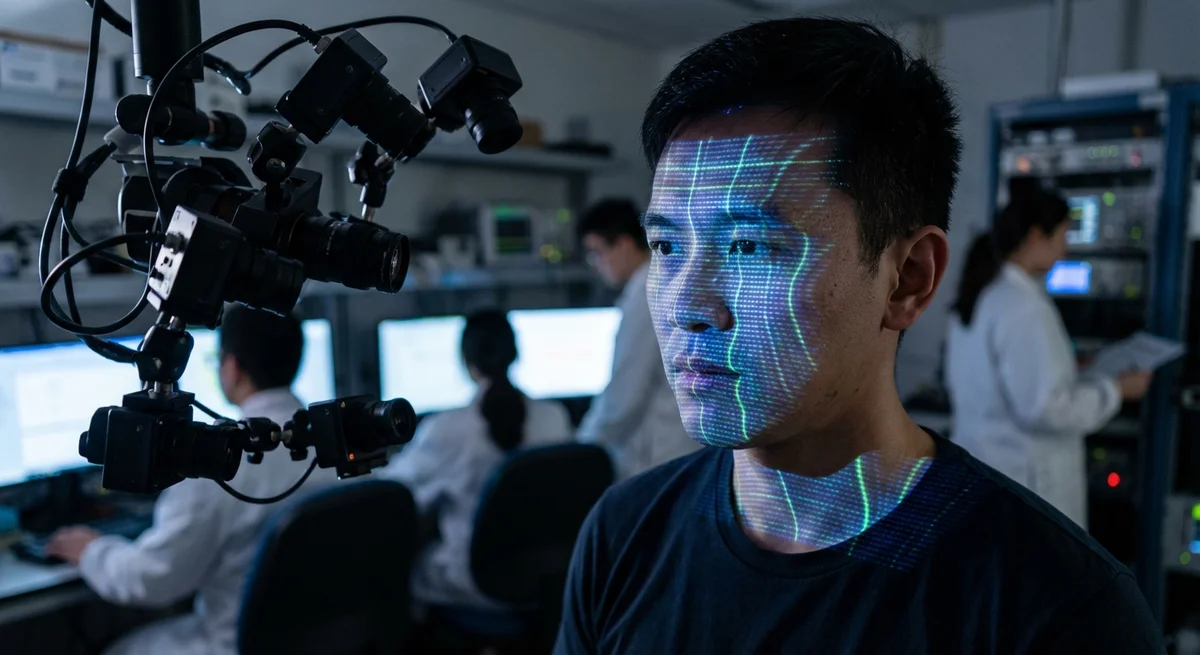
Apple is doing what it does best once again: quietly acquiring technologies that in a couple of years we'll perceive as perfectly natural. This time, the focus fell on the Israeli startup Q.ai. These guys are dealing with something quite specific, but extremely promising — they teach algorithms to understand human facial expressions and literally read non-verbal signals. If your iPhone previously just recognized your face to unlock the phone, soon it will start understanding what you're feeling and what you're about to do, even if you don't say a word.
To understand the scale of this event, it's necessary to recall the history of Apple's relationships with Israeli engineers. This is far from the first time Cupertino has sought talent in this region. It was there that the technologies that became the foundation for FaceID after the purchase of PrimeSense were born. Apple methodically builds an ecosystem where interaction with a device becomes as natural as possible. We've already traveled the path from buttons to touchscreens and from touchscreens to voice. Now comes the era of the silent interface, where even voice becomes redundant.
What exactly can Q.ai do and why is this so important right now? Their developments allow for analyzing microexpressions and facial muscle movements with incredible precision. In the context of Vision Pro, this sounds like the missing puzzle piece. One of the main problems with modern VR and AR headsets remains transmitting the living emotions of an avatar and control without bulky controllers. If the system knows that you've slightly clenched your jaw or squinted, it will be able to interpret this as a command or change of context. This solves the problem of social awkwardness, when the user has to loudly give Siri commands in public places, attracting unwanted attention.
But it's not just about mixed reality headsets. Imagine Siri that doesn't just wait for a keyword, but understands from your facial expression that you're dissatisfied with the answer or seeking confirmation of your thought. This is a fundamental transition from reactive AI, which simply responds to queries, to proactive AI that reads context before you formulate it. Apple is clearly betting on multimodality. While Google and OpenAI compete over whose chatbot writes better essays, Tim Cook and his team are building a bridge between biology and silicon, turning the camera into a full-fledged sense organ.
Of course, a reasonable question about privacy arises here. If Apple starts collecting detailed data about how the muscles in our face move in response to certain content, this will become a goldmine for behavioral analysis and, simultaneously, a potential nightmare for privacy advocates. However, the company has spent years building an image as a privacy defender, shifting all computations onto the device itself. Most likely, Q.ai's algorithms will work locally inside A and M series chips, which will give Apple a huge advantage over competitors' cloud solutions, which need to send data to servers.
The technology of silent speech or silent speech — this is not just about convenience, but also about inclusivity. For people with speech impairments, Q.ai's developments could become a real lifesaver, allowing them to communicate with the world through a digital intermediary that understands the slightest articulation. Apple has always paid enormous attention to accessibility features, and this acquisition fits perfectly into their philosophy. We see how the company brings together different directions: from neural network engines to advanced image capture sensors, creating a platform for the next technological leap.
In the long term, this could lead to completely abandoning the methods of input we're used to in certain scenarios. Why type or speak if the device understands your intentions through facial expressions? This opens doors for using gadgets in conditions of absolute silence or in very noisy places where voice is useless. Cupertino is playing the long game, and Q.ai is an investment in the decade when the line between human and computer will become almost transparent, and devices will start understanding us better than we understand ourselves.
Main point: Apple is preparing the ground for interfaces of the future, where control will happen at the level of intentions and facial expressions. Are we ready for our smartphones to know more about our mood than our loved ones?
Want to stop reading about AI and start using it?
AI News is a curated feed of AI/tech news. Hamidun Academy teaches you to use AI systematically in your work.