Project Genie: Google Hands Over the Keys to Infinite Game Worlds
While everyone is debating how realistically Sora draws cat fur, Google decided to come out swinging and give users what we've been so desperately missing in…
AI-processed from DeepMind Blog; edited by Hamidun News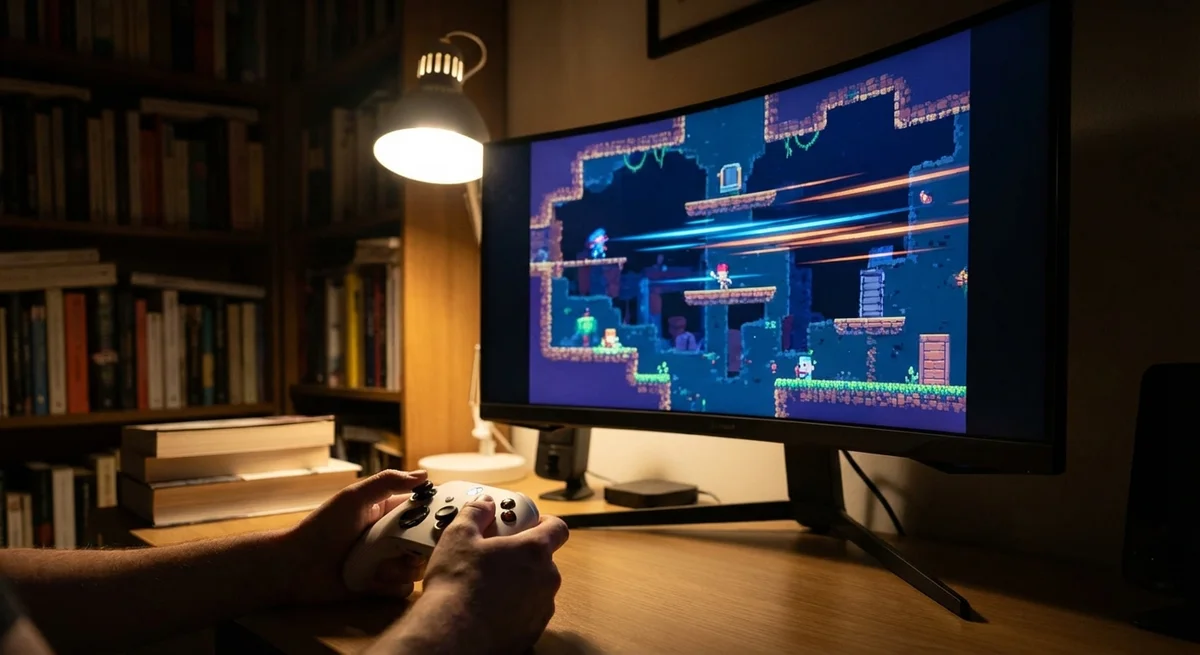
While everyone is debating how realistically Sora draws cat fur, Google decided to come out swinging and give users what we've been so desperately missing in generative video—control. Project Genie has finally emerged from closed research papers and become available to real people, though for now only to AI Ultra subscribers in the US. In a nutshell, it's not just a "cartoon generator," but a full-fledged world engine that creates interactive space literally from nothing.
Let's recall how this used to work. You wrote a prompt, waited a minute, and got a beautiful video. Beautiful? Yes. Useful? Well, maybe for social networks. But you remained a spectator. Project Genie changes the rules of the game. Google calls this a "foundation world model." The essence is that the system was trained on hundreds of thousands of hours of video from platformers and other games, with no annotations whatsoever. The AI itself understood that if a character presses a button, it should jump, and if there's a wall in front of it, it can't pass through. This intuitive understanding of physics and mechanics used to require thousands of lines of code to implement.
Launching this prototype now is not just an attempt to catch up with OpenAI—it's a demonstration of a different approach. Google is trying to prove that the future of AI isn't in passive content consumption, but in creating interactive environments. Imagine you describe your dream game: "cyberpunk platformer in neo-noir style," and a second later you're already controlling a character in this world. For now, Genie works mainly with 2D spaces reminiscent of old console games, but the potential for scaling here is enormous. We're seeing the first steps toward what the industry calls "generative games."
Of course, Google wouldn't be Google if it didn't limit access. Only the US, only the paid Ultra subscription. This looks like an attempt to test the waters and understand if people are willing to pay for the ability to play with neural network hallucinations. But what's important here is different: Genie proves that complex interaction logic no longer requires rigid algorithms. The model learns the rules of the world simply by observing it. This is critically important not just for games, but for robotics, where machines need to understand the consequences of their actions in real space.
What does this mean for the industry as a whole? Game development as it currently exists may face a serious identity crisis. If any person can generate levels and mechanics on the fly, the value of standard assets and template quests will plummet to zero. We're entering an era where creativity is limited only by imagination, and technical barriers to entry into game development are crumbling before our eyes. While Genie is still a fun toy for geeks, in a couple of iterations it could turn into a tool that leaves thousands of level designers without work.
The bottom line: Google is shifting generative AI from "watch" mode to "play" mode, and is this the beginning of the end for traditional game development?
Want to stop reading about AI and start using it?
AI News is a curated feed of AI/tech news. Hamidun Academy teaches you to use AI systematically in your work.