Quantum Refrigerator: Swedes Made Noise Work for Processor Benefit
Физики из Технического университета Чалмерса совершили невозможное: они создали квантовый холодильник, который питается электромагнитным шумом. В обычных услови
AI-processed from Science Daily AI; edited by Hamidun News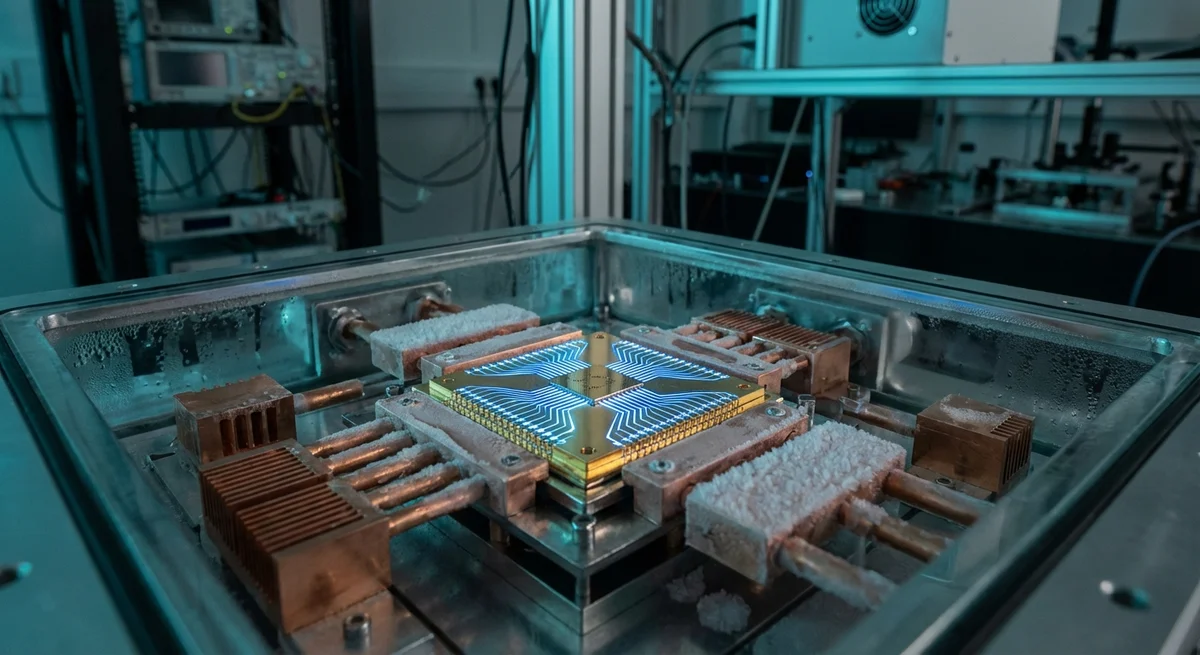
Imagine you are trying to sleep in a room with a drill running, but instead of getting annoyed, you use the sound of the impacts as a source of energy for your morning run. It sounds absurd, but this is exactly what Swedish physicists in quantum computing have pulled off. They created a tiny device that turns electromagnetic noise—the eternal curse of any quantum engineer—into useful energy for cooling the system. This is not just an elegant laboratory trick, but a potential solution to a problem that has been holding back the entire industry for years.
To understand the scale of the event, you need to recall the conditions in which modern quantum processors live. Qubits are extremely delicate creatures. The slightest thermal fluctuation or random electromagnetic wave causes them to lose their superposition state, turning the most complex computational process into useless debris. Therefore, such computers are usually hidden in huge cryostats, where temperatures close to absolute zero are maintained. The paradox is that the cooling systems and control cables themselves inevitably generate noise. The result is a vicious circle: we try to save the system from overheating, but the tools of salvation themselves introduce chaos and destroy the computations.
Swedish researchers decided to stop fighting the inevitable and rethink the very thermodynamics of the process. They built a quantum refrigerator that not only resists noise but literally 'consumes' it. At the nanoscale, the device manages heat flows so that random fluctuations begin to work as a drive for a heat pump. This allows heat to be precisely drawn away from critical processor nodes, using that very interference energy that was previously considered garbage. The device turned out to be multifunctional: depending on the settings, it can work as a classic refrigerator, a heat engine, or even an energy amplifier within a circuit.
Why is this important right now? We have reached the point where simple extensive cooling no longer works. To build a truly powerful quantum computer with thousands of qubits, we need new methods for managing the chip's internal environment. Traditional cooling systems are too cumbersome and inefficient for such tasks. If we learn to integrate such 'noise-based refrigerators' directly into the processor architecture, this will significantly reduce the requirements for external cryostats and increase the stability of computations. This is a step from bulky laboratory monsters to more compact and reliable systems.
Of course, mass production of 'noise engines' is still far off, but the conceptual barrier has been breached. Scientists have proven that fundamental interference can not only be minimized but also exploited. This changes the rules of the game in quantum hardware design. Instead of building thicker and thicker walls around the processor, we can teach it to convert a hostile environment into a useful resource. Perhaps the future of quantum technologies lies not in perfect silence, but in the ability to properly conduct inevitable chaos.
The key point: the main disadvantage of quantum systems has been turned into their advantage. Will hardware developers now be able to abandon giant cryogenic 'chandeliers' in favor of compact chips?
Want to stop reading about AI and start using it?
AI News is a curated feed of AI/tech news. Hamidun Academy teaches you to use AI systematically in your work.