Robot vs. Train: Why Autonomous Delivery Loses to Reality
Imagine this scene: a high-tech device packed with lidars, cameras, and sophisticated computer vision algorithms freezes helplessly in the middle of a…
AI-processed from Futurism; edited by Hamidun News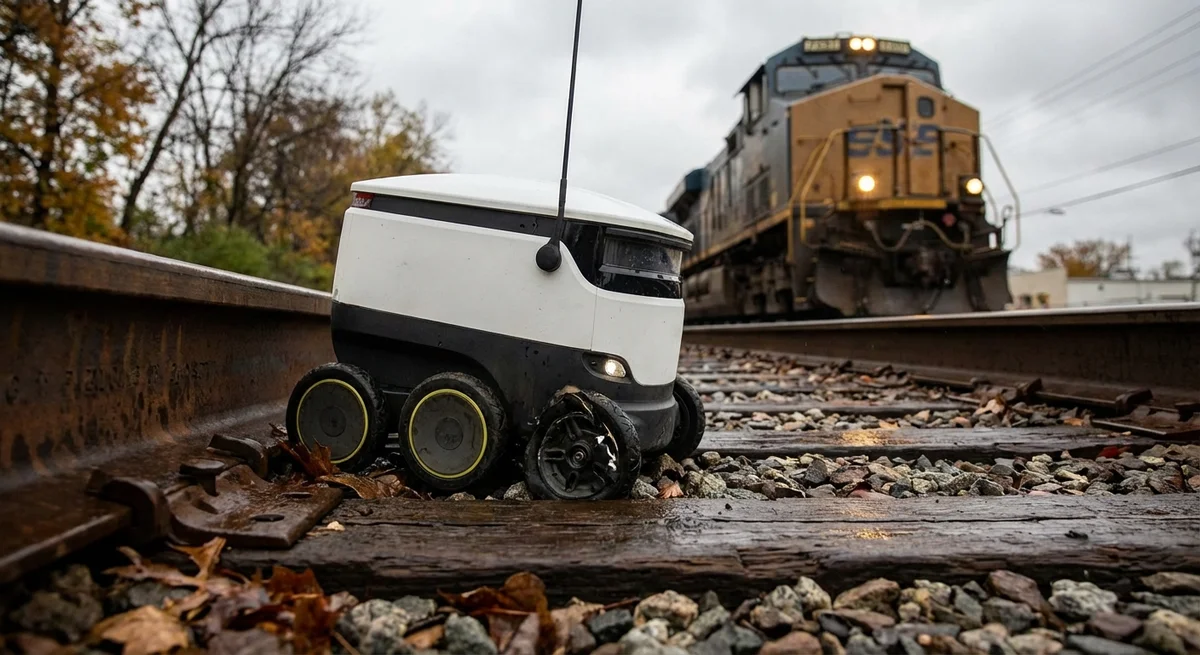
Imagine this scene: a high-tech device packed with lidars, cameras, and sophisticated computer vision algorithms freezes helplessly in the middle of a railroad crossing. A moment later, a multi-ton steel train turns this symbol of progress into a cloud of plastic debris. This is not a scene from a Hollywood blockbuster about a machine uprising, but harsh reality, in which autonomous delivery attempts to survive on the streets of ordinary cities. A video of a delivery robot being destroyed by a locomotive spread quickly across the internet, prompting some to smile ironically, and others to ask serious questions about the safety of the entire autonomous systems industry.
We've grown accustomed to hearing that robots are about to transform logistics, making food and package delivery practically free. Startups like Starship Technologies or Serve Robotics have spent years conditioning us to think that small six-wheeled boxes on sidewalks are the new norm. Yet each such incident reminds us that the so-called last mile remains the most difficult and unpredictable stage of automation. The problem here is not that the robot failed to see the approaching train, but that its software could not adequately assess the risk and leave the dangerous zone in time.
Why does this happen in an era when AI defeats humans at chess and writes computer code? Developers often train algorithms in refined conditions or advanced simulations. In reality, the robot encounters mud, uneven asphalt, and those very rails that proved fatal to our story's protagonist. A railroad crossing is an extremely hostile environment for mechanisms with small wheel diameters. Metal elements can not only physically block movement but also create interference for sensors. When such a robot gets stuck, its logic often enters an infinite loop of recalculating its route instead of sending a distress signal or executing an emergency maneuver.
This case exposes a fundamental problem — the absence in modern autonomous systems of what we call common sense. A machine can be taught to recognize thousands of objects, but teaching it to understand the physical context of danger is orders of magnitude more difficult. For a robot, a train is simply an array of data, a moving object with a certain velocity vector. It does not realize that this object cannot brake instantly. Until such contextual understanding is embedded in the very architecture of decision-making, we will continue to witness collisions between technologies from different eras.
For the entire robotics industry, this is a warning sign. If tomorrow such a courier gets stuck not on tracks, but in the path of an ambulance or causes a serious accident involving people, the consequences will be far grimmer than the loss of a few sensors and a chassis. Regulators in various countries are already viewing with suspicion how autonomous vehicles share space with pedestrians. Such fiascos provide excellent justification for introducing strict restrictions that could slow industry development for decades. We need to acknowledge: railways and robots are still living in different dimensions.
Main point: Autonomous technologies remain critically dependent on infrastructure created by humans for humans. Until robots learn to adequately respond to non-standard physical obstacles, their mass presence on city streets will remain an expensive and sometimes dangerous experiment.
Want to stop reading about AI and start using it?
AI News is a curated feed of AI/tech news. Hamidun Academy teaches you to use AI systematically in your work.