Thermodynamic Computer: AI Learns to Draw Almost for Free
Индустрия ИИ столкнулась с энергетическим тупиком: обучение моделей требует гигаватт энергии, а чипы Nvidia стоят как самолеты. Исследователи из США предложили
AI-processed from 3DNews AI; edited by Hamidun News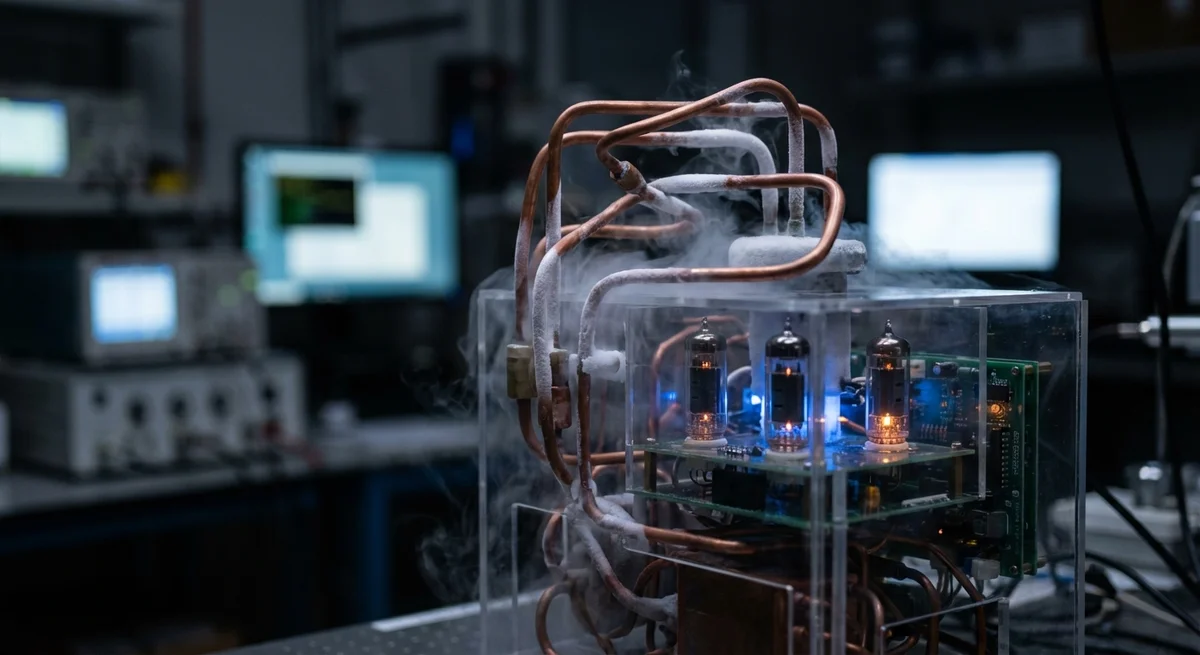
We've reached a point where artificial intelligence's appetites have become its primary bottleneck. Every time a neural network draws you a cat in cyberpunk style, somewhere deep in a data center, a noticeable amount of electricity burns up. We're trying to force digital transistors to imitate the work of a biological brain, and physics presents us with an enormous bill for this. But what if we stop fighting heat and chaos and make them work for us? American scientists have proposed using a thermodynamic approach that could make modern GPUs look like steam engines compared to a nuclear reactor.
The essence of the problem lies in the very architecture of modern computers. Since the middle of the last century, we've been obsessed with deterministic logic. A bit is either zero or one, and any deviation is considered an error that must be suppressed. Suppressing this costs an enormous amount of energy. Modern diffusion models, which create images, essentially engage in finding order in noise. The irony is that our hardware spends 99% of its energy fighting the very noise it's trying to model. It's like trying to draw a perfect circle with a jackhammer: the result is possible, but the effort is disproportionate.
The proposed thermodynamic computer takes a different path. Instead of simulating random processes through billions of transistor switches, it uses the system's natural physical fluctuations. In simple terms, it lets physics do all the mathematical work. When you use a system that naturally tends toward a certain energy state, you don't need to pump megawatts into it to "compute" that state. You simply let it happen. Researchers have proven that for certain operations in image generation, this approach is ten billion times more efficient than the traditional approach.
This is not just a curious experiment from a university laboratory, but a vital necessity. We've hit a wall: further scaling of AI requires building personal nuclear power plants for each major company. If we want to see AI in every smartphone, sensor, or even coffee maker, we need an architecture that doesn't require its own power grid. Thermodynamic computing offers a transition from the paradigm of "computing as fighting nature" to "computing as cooperating with nature." Most amusingly, our brain operates much closer to these thermodynamic systems than to the H100 chips that Silicon Valley prays to today.
Of course, the path from a scientific paper to an actual device will be long and complex. Building stable and programmable thermodynamic hardware is an engineering nightmare. We'll need new compilers, new programming languages, and a completely different way of thinking. You can't just copy Python code and run it on a system that computes using thermal fluctuations. However, the potential prize—a ten-billion-fold efficiency advantage—is too large to ignore. This is the type of technological leap that changes civilizations, not just profit reports.
If this technology matures, the landscape of the AI industry will change overnight. Power will cease to belong to those who can buy the most silicon. It will pass to those who best understand the physics of the processes. We may find ourselves in a world where the most complex video generation happens on a coin-sized device, running on a tiny battery for weeks. Computing will become as cheap and accessible a resource as air. The only question is how quickly we can tame this managed chaos.
Main point: We've reached the limit of digital architecture, and salvation came from fundamental physics. If thermodynamic computing becomes reality, the era of traditional GPU dominance will end faster than we can realize it. Are we ready to trust the future to systems that literally work on the energy of chaos?
Want to stop reading about AI and start using it?
AI News is a curated feed of AI/tech news. Hamidun Academy teaches you to use AI systematically in your work.