Snowy Apocalypse: When Reality Looks Like a Bad Prompt for Sora
Кадры городов, ушедших под снег по самую крышу, заполонили соцсети. Для индустрии ИИ это важный звонок: пока мы учим модели генерировать гиперреалистичные видео
AI-processed from Futurism; edited by Hamidun News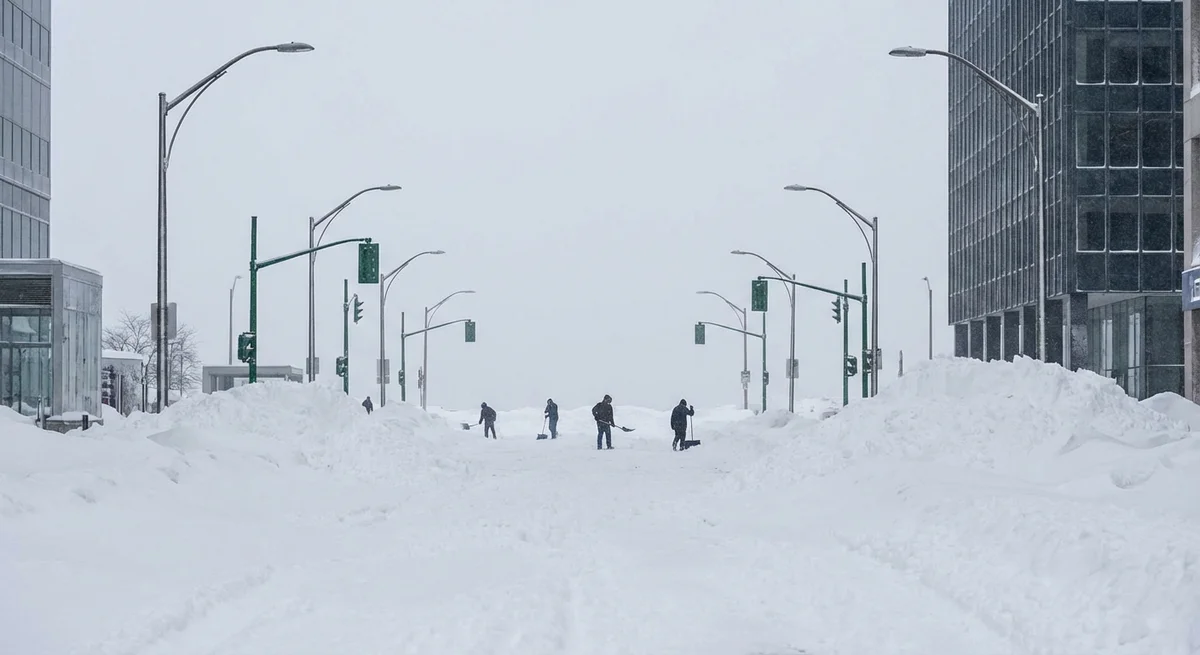
Look at these clips from social media: cities are literally wiped off the map by meters-deep layers of snow. If I told you this was a new demo reel from OpenAI or Runway, you'd probably believe it. We've reached a point where real natural disasters inspire less trust than neural network generations. But behind viral videos lies a serious problem for our entire cozy tech bubble. While we debate whether ChatGPT will replace programmers, the real world is throwing challenges that modern AI simply hasn't learned to solve.
The context is straightforward: the last two years have been a time of "meteorological hype" in AI. Google DeepMind launched GraphCast, NVIDIA is building Earth-2, and Huawei is pushing Pangu-Weather. These models promised us a revolution, predicting weather in seconds with accuracy that traditional numerical methods on supercomputers can't achieve. The irony is that when it comes to extreme "black swan" events like this epic snowstorm, the touted neural networks often deliver results no better than fortune telling. And here's why.
The main problem is that AI is essentially a very complex machine for averaging experience. It's trained on historical data from the last 40-50 years. If that sample doesn't contain an anomaly of this scale, the model simply can't imagine it. For a neural network, such an event is statistical noise that needs to be "smoothed out." As a result, we get a situation where AI excels at predicting tomorrow's rain in London, but is completely blind in the face of a catastrophe that happens once a century. This is a fundamental architectural limitation: models work well within the data distribution but get lost beyond it.
There's another aspect—ironic and somewhat frightening. We're pouring billions of dollars into generative AI so it can draw us beautiful pictures of apocalypse. We're teaching Sora to understand how light falls on snowflakes and how drifts move. But at the same time, we're spending far fewer resources on teaching AI to understand the physics of these processes at the level of forecasting. We're building digital mirrors of reality that look flawless but lack solid ground beneath them. As a result, the picture on your smartphone becomes more "real" than the snowdrift outside your window that paralyzes data centers and logistics.
What does this mean for the industry? It's time we acknowledged that a purely statistical approach in AI has hit a ceiling. The future lies not with massive language models, but with hybrid systems—the so-called Physics-informed Neural Networks (PINNs). These are neural networks that have the laws of thermodynamics and hydrodynamics wired into their "brains" at the architectural level. Only then can we move from simply drawing pixels to actually managing risks in the physical world. For now, we can only watch videos and marvel at how nature easily outperforms any graphics processor.
Bottom line: nature remains the best content generator, and our AI models are still too dependent on the past to predict the future. Waiting for when meteorological startups start hiring physicists as aggressively as they hire prompt specialists?
Want to stop reading about AI and start using it?
AI News is a curated feed of AI/tech news. Hamidun Academy teaches you to use AI systematically in your work.