End of chalk era: AI starts proving theorems for humans
Эра автоматических математических доказательств официально наступила. Проект Numina-Lean-Agent показал, что ИИ способен не просто угадывать ответы, а строить ст
AI-processed from Import AI; edited by Hamidun News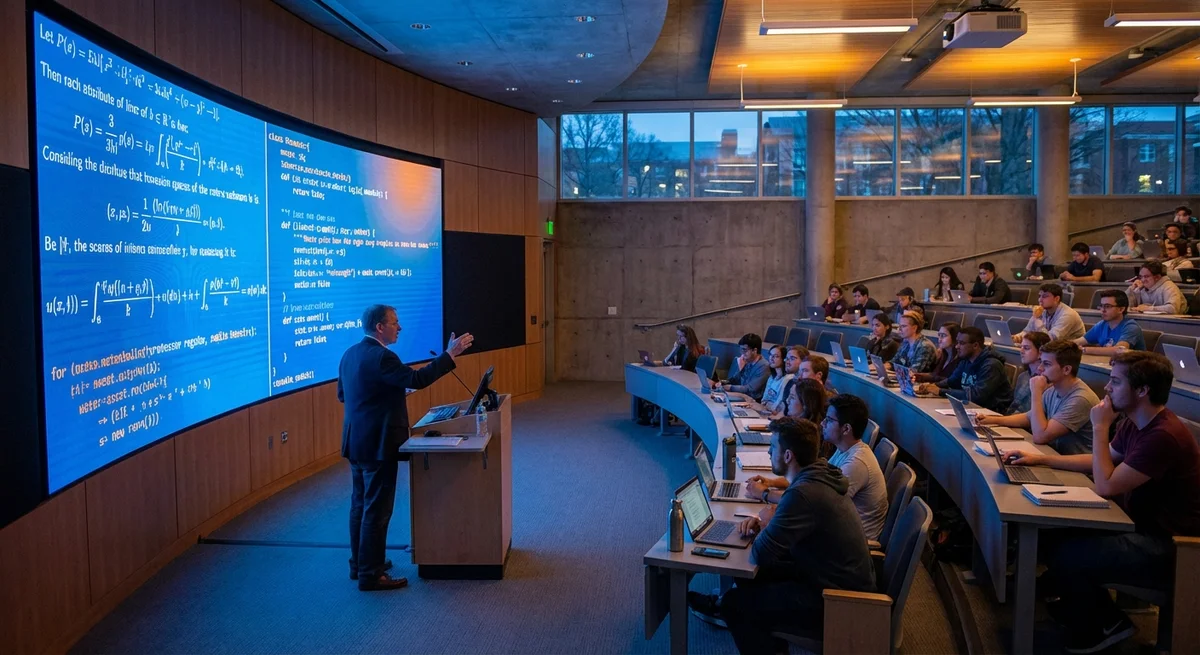
For a long time, we lived with a comforting belief that mathematics was the last bastion of pure human intelligence. We forgave language models their ridiculous arithmetic mistakes, considering that creative insight in theorem proofs was inaccessible to them by definition. But a fresh issue of Import AI and the Numina-Lean-Agent project unambiguously hint that it's time to remove the rose-tinted glasses. Mathematics is no longer a safe haven for humans, but becomes a battlefield for algorithms of formal verification.
The essence of the changes lies in the transition from simple next-word prediction to working in strict logical environments like Lean. If previously a neural network simply tried to guess the answer, now Numina-Lean-Agent acts as an agent that writes code to verify its hypotheses in real time. It's as if a student didn't just write a solution to a problem in a notebook, but immediately checked it on a supercomputer that doesn't allow a single logical error.
Such an approach transforms mathematical search from intuitive wandering in the fog into a purposeful engineering process. This fundamentally changes the rules of the game: now the speed of scientific discoveries is limited only by computational power, not by the number of brilliant minds on the planet.
However, the automation of science is only one side of the coin. While academics rejoice at new tools, something less encouraging is happening in the shadow sector of the economy. This is about the industrialization of cyberspying. If previously conducting a complex attack required a group of highly qualified hackers, now AI allows this process to be put on an assembly line. Neural networks take on the routine: vulnerability searching, exploit writing, and social engineering on an industrial scale. This creates a dangerous imbalance in the security economy. Attack costs are plummeting, while defense costs continue to rise. We are entering an era where cyber wars are waged not by individual masters, but by huge automated code factories.
The economic landscape of the AI industry is also beginning to crystallize, revealing clear winners and losers. We see the classic picture of capital concentration: those who own huge GPU clusters dictate the rules of the game. But the irony is that the open-source community is not giving up. Projects like Numina show that with the right approach to data and architecture, you can achieve results comparable to closed giants. The question is only how long this parity will last before the cost of training next-generation models becomes unaffordable even for the largest consortiums.
What does this mean for us? We are witnessing AI cease to be merely a "smart assistant" and become a full participant in the production of knowledge and threats. When a machine begins to prove theorems that a human cannot verify without the help of another machine, we move into a new phase of civilization's development. This is no longer just the automation of labor, but the automation of logic itself. And if we don't learn to control this process at a fundamental level, we risk finding ourselves in a world where all important decisions are made in "black boxes," whose logic is flawless, but utterly incomprehensible to our biological brain.
Main takeaway: Mathematics has officially become an engineering discipline, and cyberspying has become an industrial sector. Are we ready for a world where human intelligence is no longer the fastest way to search for truth?
Want to stop reading about AI and start using it?
AI News is a curated feed of AI/tech news. Hamidun Academy teaches you to use AI systematically in your work.