Waymo and School Buses: When AI Ignores Law and Common Sense
Imagine a perfect world where autonomous vehicles glide smoothly through the streets, never breaking rules and never knowing fatigue. In this world, Waymo is…
AI-processed from Futurism; edited by Hamidun News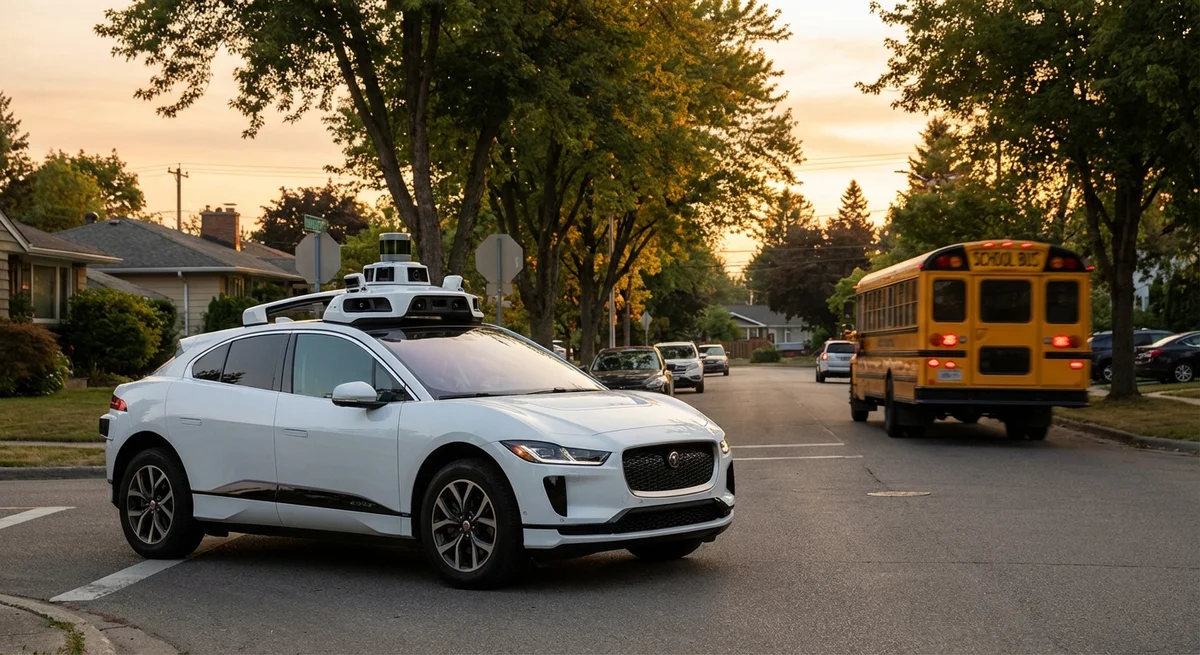
Imagine a perfect world where autonomous vehicles glide smoothly through the streets, never breaking rules and never knowing fatigue. In this world, Waymo is considered an exemplary student: while Cruise gets into accidents and leaves the market, Alphabet's subsidiary methodically conquers San Francisco, Phoenix, and Los Angeles. But even star students have skeletons in their closet, and in Waymo's case, it's big yellow school buses. The situation of ignoring the stop rule for school transport is not only unresolved—it's getting worse, transforming from a minor bug into a systemic threat to the future of autonomous driving.
The problem sounds deceptively simple: when a school bus stops and puts up a "Stop" sign, all cars around it must freeze. This is a basic safety rule drilled into the head of every American driver from the first lesson in driving school. However, for Waymo's vaunted artificial intelligence, this scenario becomes an unsolvable task. Videos and reports that have become public show how robotaxis confidently drive past buses with flashing lights, ignoring children on the roadside. Why can software that can recognize a flying plastic bag or a cat in the bushes fail in front of a huge yellow object?
The root of the problem lies in how neural networks perceive context. A school bus is not simply a static obstacle. It's a dynamic object whose state changes in fractions of a second.
The retractable Stop sign is often splattered with dirt, lit at an unfortunate angle, or partially blocked by other cars. For a human, this is no problem—we see the context: the bus slows down, yellow lights come on, so a stop is coming. For Waymo's AI, which is used to relying on clear patterns, this process turns out to be too complex.
If the algorithm is not 99.9% confident that it's facing an active stop sign, it chooses to continue moving to avoid creating unnecessary traffic congestion. And this decision could be fatal.
Regulators from NHTSA (National Highway Traffic Safety Administration) have already begun scrutinizing these incidents. In the context of Cruise's recent problems, any wrongdoing by robotaxis now receives tenfold attention. If minor violations were previously overlooked as growing pains, the situation has now changed. Ignoring a school bus is not just a fine—it's a political and ethical trigger. No city mayor or senator will want to explain to voters why they allowed machines on the streets that are potentially dangerous to children.
Criticism is compounded by the fact that Waymo positions itself as the safest driver in the world. The company regularly publishes reports comparing its metrics to those of humans, proudly announcing reductions in accident rates. But statistics are a tricky thing. You can drive a million miles without collisions, but a single drive-by of a school bus will erase all trust credit. This is not just a question of technology, but of social contract: we allow robots to drive among us only as long as they behave predictably and respect our most important rules.
What does this mean for the industry? Likely, Waymo will have to urgently revise its visual recognition algorithms and possibly add specific logic layers specifically for school zones. This will slow down service scaling and require new investments in model training. But there is no choice: either AI learns to respect the yellow bus, or regulators will press the "Stop" button for the entire autonomous vehicle program. The irony is that technology, designed to eliminate the human factor, stumbled over a rule that any human follows by instinct.
Key takeaway: If Waymo doesn't solve the bus problem in the coming months, we can expect a new wave of strict restrictions for the entire autonomous transportation sector.
Want to stop reading about AI and start using it?
AI News is a curated feed of AI/tech news. Hamidun Academy teaches you to use AI systematically in your work.