Tesla Cybercab: when 'Full Autopilot' needs a babysitter on its tail
Tesla Cybercab: When "Full Autopilot" Needs a Babysitter on Its Tail Elon Musk is a master illusionist and maker of grand gestures. When he rolled out the…
AI-processed from Futurism; edited by Hamidun News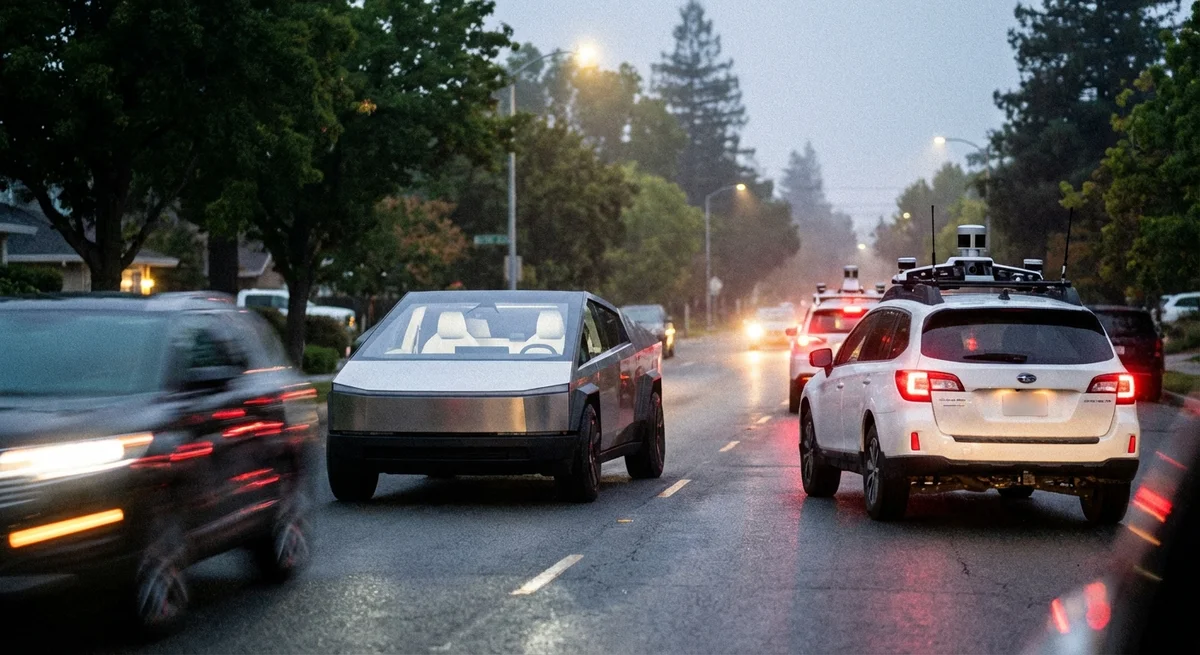
Tesla Cybercab: When "Full Autopilot" Needs a Babysitter on Its Tail
Elon Musk is a master illusionist and maker of grand gestures. When he rolled out the golden Cybercab onto the Warner Bros. studio stage, the world saw a future where there is no room for steering wheels, pedals, and most importantly, drivers. "There's nobody in the car," he declared proudly, gesturing to the empty cabin. And he wasn't lying. Technically, there was indeed nobody in the cabin. However, as is often the case with Tesla's promises, the devil is in the details, and in this case—in the rear-view mirror. Recent reports and eyewitness accounts indicate that behind each "autonomous" Tesla prototype cruising the streets, a regular vehicle with live people inside secretly follows.
The situation resembles that awkward moment when a child rides a bicycle for the first time and the father runs behind, ready to catch him at any second. Only in Tesla's case, that "father" is a team of highly paid engineers and safety operators packed into a support sedan. Let's recall the context: Tesla has been selling the Full Self-Driving (FSD) package for years, which, despite its ambitious name, still requires constant human attention. The transition to Robotaxi is Musk's attempt to make a quantum leap from level two autonomy directly to level five, skipping all intermediate stages. But regulators and the harsh realities of road traffic are relentless.
Why is it important to understand this right now? Because the entire robotaxi economy that Musk paints for investors is built on radically cutting costs by eliminating human labor. If operating one autonomous vehicle still requires a person—and in this case, an entire vehicle with staff—the business model turns into a pumpkin. This is not a scalable technology of the future, but a very expensive and cumbersome performance. Musk promises ride costs on par with a bus ticket, but so far every mile traveled by Cybercab costs the company many times more than a regular Uber ride.
Skeptics might argue this is merely a necessary testing phase. Optimists would add that in this way the company is gathering unique data to train neural networks in real, not simulated, conditions. But the irony is that Tesla has always positioned itself as a leader that stands ahead of everyone thanks to "pure" vision and the power of its algorithms. The presence of a physical "tail" of safety personnel indicates that the engineers have far less confidence in the system than the marketing department does. This creates a dangerous precedent: instead of a finished product, we are shown its imitation, hoping that the algorithms will "learn" along the way.
In the autonomous transportation industry, trust is the most expensive and scarce currency. Competitors like Waymo have already gone through painful stages and are now operating driverless vehicles in several states, relying on remote monitoring. Tesla's decision to use physical support vehicles looks like a technological step backward. This is not only inefficient, but also raises questions about whether Tesla's vision can even cope with the chaos of city streets without external assistance. If you can't send a car out alone on an empty road in Palo Alto, how do you expect to launch a mass service in megacities?
Ultimately, the story of pursuit vehicles underscores the enormous gap between demo videos and reality. We all want to believe in a science fiction future, but so far that future requires gasoline for the support vehicle. Musk has once again proven that he knows how to sell a dream, but the price of that dream includes hidden costs that aren't discussed in presentations. Until Cybercab learns to get rid of its "tail," it will remain an expensive attraction, not a transportation revolution.
The key takeaway: Will Tesla ever be able to rid itself of the "insurance" vehicle, or is Cybercab doomed to eternal escort?
Want to stop reading about AI and start using it?
AI News is a curated feed of AI/tech news. Hamidun Academy teaches you to use AI systematically in your work.