Rubik's Cube: A Testing Ground for Intelligence and AI Development
The Rubik's Cube is not just a puzzle. It has become a universal metaphor for complex systems, reflecting challenges in politics, management, and even in…
AI-processed from Habr AI; edited by Hamidun News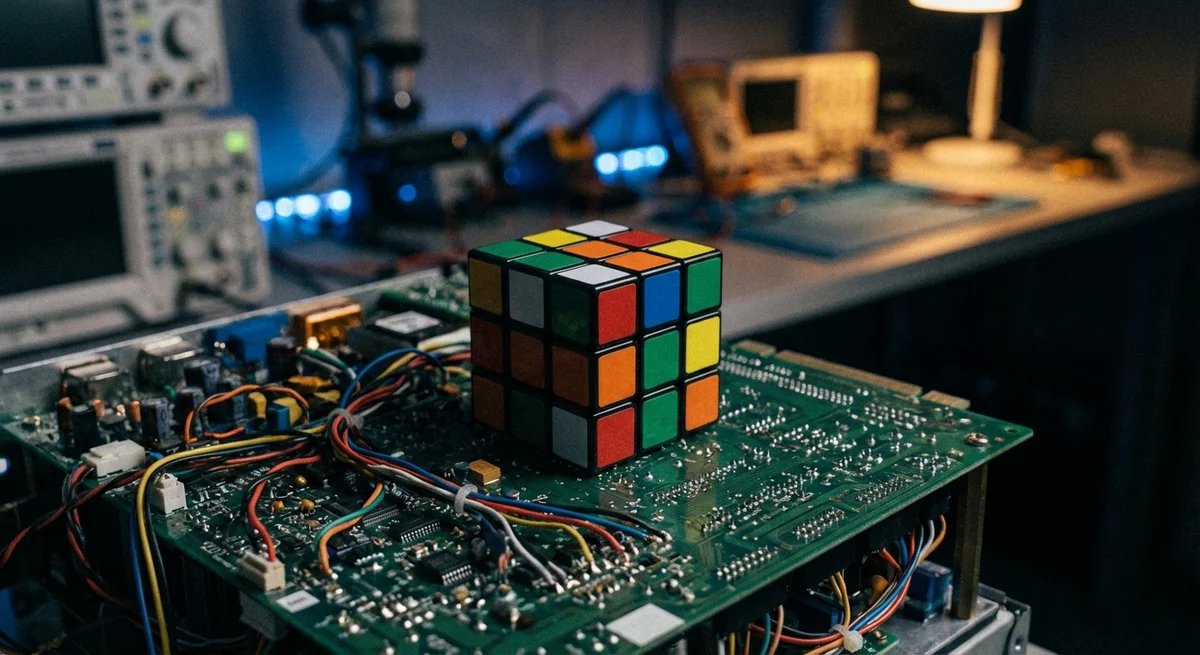
The Rubik's Cube is not just a puzzle. It has become a universal metaphor for complex systems, reflecting challenges in politics, management, and even in understanding human intelligence. For more than half a century, this object symbolizes tasks that require analysis, patience, and systems thinking. But few know how profoundly this toy has influenced the development of artificial intelligence.
Almost immediately after its appearance, the Rubik's Cube attracted the attention of AI pioneers. In the early 1980s, mathematicians and programmers saw in it an ideal formalized discrete world: with strict rules and an enormous search space. Unlike chess or Go, the Rubik's Cube offers a finite, though very large, number of states, making it an ideal testing ground for algorithm development and testing.
The first solutions found with computers were based on classical algorithmic approaches. Programmers developed heuristic search methods that allowed them to find optimal sequences of moves to solve the puzzle. These early works laid the foundation for the development of more complex algorithms used today in various fields of AI.
With the development of machine learning, the Rubik's Cube received new life. Neural networks proved capable not only of solving the puzzle but also of learning strategies that surpass human ones. Reinforcement learning methods allow agents to independently explore the state space and find optimal solutions without explicit programming.
The influence of the Rubik's Cube on AI extends beyond puzzle-solving algorithms. It has become an important tool for studying the general principles of intelligent behavior. Research in this area helps better understand how to create systems capable of learning, adaptation, and solving complex problems in various fields – from robotics to finance.
The Rubik's Cube continues to inspire researchers today. It remains a relevant testing ground for testing new algorithms and approaches in AI. The development of computational power and the emergence of new machine learning methods open new possibilities for solving this classic puzzle. And who knows what other discoveries await us along this path.
In conclusion, the Rubik's Cube is not simply a childhood toy, but a powerful tool for the development of artificial intelligence. Its history shows how a simple task can stimulate scientific research and lead to important discoveries that influence the development of future technologies.
Want to stop reading about AI and start using it?
AI News is a curated feed of AI/tech news. Hamidun Academy teaches you to use AI systematically in your work.