Adobe buys Topaz Labs — AI upscaling tools to enter Creative Cloud
Adobe buys Topaz Labs — a company whose upscaling and noise reduction algorithms are considered the standard among professional photographers and…
AI-processed from TechCrunch; edited by Hamidun News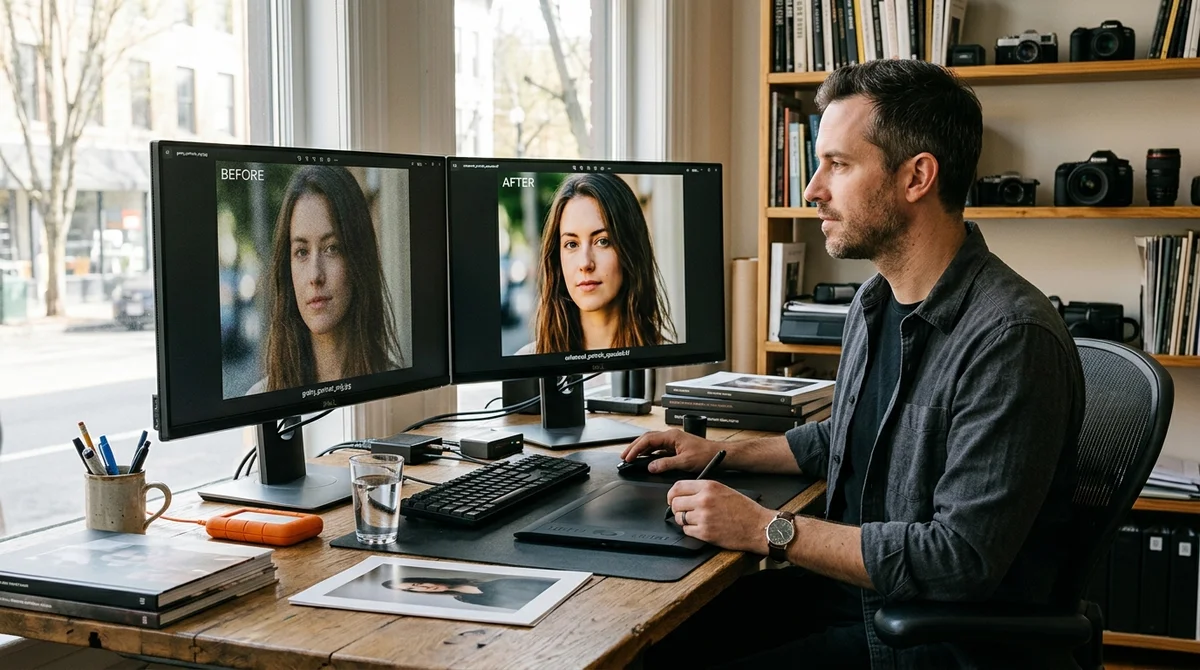
Adobe has announced the acquisition of Topaz Labs, an American developer of artificial intelligence-based tools for improving image and video quality. According to the company, Topaz technologies will be integrated across Adobe's entire application lineup.
Who is Topaz Labs
Topaz Labs specializes exclusively in neural network algorithms for visual content processing. The company does not attempt to compete with Adobe across the board: its products solve narrow but critically important tasks — and do it better than most competitors on the market. The company's flagship products:
- Topaz Photo AI — upscaling, noise reduction, and sharpening for photographs
- Topaz Video AI — video restoration and upscaling, frame interpolation
- Topaz DeNoise AI — specialized noise removal for RAW files
- Topaz Sharpen AI — detail recovery for blurry images
- Topaz Gigapixel AI — image upscaling with texture preservation
Professional photographers and videographers have long used Topaz as a mandatory supplement to Lightroom and Premiere Pro. The company's algorithms are considered the industry standard in the niche of visual content enhancement.
Why Adobe is making this deal
Adobe is actively building its own AI stack under the Firefly brand. Over the past years, the company has embedded neural network features into Photoshop, After Effects, Premiere Pro, and Lightroom: generative fill, object removal, automatic color correction. However, in the upscaling and noise reduction niche, independent solutions — primarily Topaz — maintained a significant quality advantage.
Acquiring Topaz Labs allows Adobe to immediately close this gap: the technologies, reputation within the professional community, and loyal user base transition under Creative Cloud control. At the same time, the deal eliminates one of the few tools that prompted some professionals to continue using third-party software alongside the Adobe package.
"Adobe will integrate
Topaz Labs tools into its applications," the company said in an official statement.
How user experience will change
The most likely integration scenario is that Topaz features will appear directly in Photoshop, Lightroom, and Premiere Pro as part of the Creative Cloud subscription. For Adobe users, this means access to powerful upscaling and noise reduction without a separate purchase. Current users of Topaz Photo AI and Topaz Video AI may face uncertainty: licensing terms will change, and the products themselves will likely gradually move under the Adobe umbrella or cease to exist as standalone solutions. Part of the professional community is already expressing concerns — Topaz's independence from Adobe was considered one of the product's advantages, allowing the company to develop at its own pace.
What it means
Adobe is systematically consolidating professional tools under a single brand, eliminating alternatives to Creative Cloud. The purchase of Topaz Labs is both a technological strengthening of the product and a strategic reduction of competition in the professional media processing segment. For the market, the signal is unambiguous: in the AI era, Adobe does not intend to allow niche competitors to establish themselves in its audience.
Need AI working inside your business — not just in your newsfeed?
I build production AI for companies — custom CRM, internal tools, autonomous agents, workflow automation. Owned by you, shaped to your process, no per-seat tax. Built by Zhemal Khamidun, CPO of AlpinaGPT (AI platform, 6,000+ users).