China eliminates 12,000 university specialties in favor of AI programs
China is eliminating 12,000 university specialties — translation studies, art history, management, and dozens of other humanities programs. Youth…
AI-processed from CNews AI; edited by Hamidun News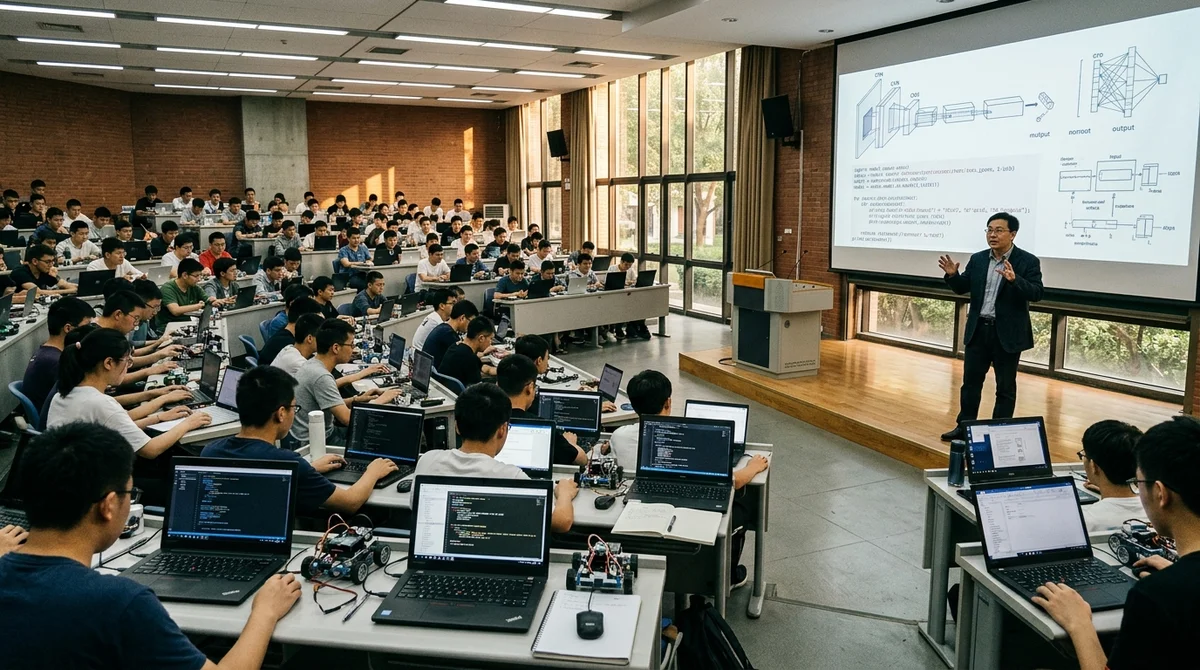
China is closing 12,000 university specialties and replacing them with AI programs. The scale of the reform is unprecedented: it concerns one-third of all bachelor's degree tracks in the country.
What's being closed and why
Primarily affected are humanities and creative specialties: translation studies, art history, management, public administration, library science, and several journalism and cultural studies tracks. These are precisely the disciplines with the worst graduate employment rates. The Chinese Ministry of Education officially justifies the decision by two factors.
First is the sharp rise in youth unemployment: in 2025, the rate for the 16–24 age group exceeded 20%, reaching a historic high. Second is technological change: tasks that were once performed by translators, research assistants, and document management specialists are increasingly being solved by AI tools. Demand for these professions is falling faster than universities can respond.
Essentially, the state publicly acknowledges the obvious: the labor market is not ready to absorb hundreds of thousands of humanities graduates annually. Data engineers, AI developers, and automation specialists, by contrast, are catastrophically in short supply. The imbalance has accumulated over years—now authorities have decided to correct it decisively and on a compressed timeline.
What will open instead New technology-oriented programs are taking the place of closed specialties.
Here's what's being opened first:
- Machine learning and neural network architectures
- Robotics and autonomous systems
- Data analysis and data engineering
- AI in medicine, biotechnology, and agriculture
- Industrial automation and smart manufacturing
- Cybersecurity and AI ethics
Leading universities in the country—Tsinghua University and Peking University—have already announced the launch of joint programs with Huawei, ByteDance, and Baidu. Students will combine academic preparation with real-world projects directly in technology companies. Corporate partnership becomes a mandatory condition for accrediting new programs—otherwise, approval from the ministry cannot be obtained. Special emphasis is placed on applied skills: graduates must be able to work with specific tools, not merely know theory. The state wants to reduce the adaptation period for young specialists to the workforce from two years to six months.
Scale of reform and timeline
The 12,000 closed programs represent approximately 30% of all bachelor's degree tracks in the country, affecting hundreds of thousands of applicants annually. The mechanism is centralized: the Ministry of Education publishes an obligatory list of programs to eliminate each year, with the pace accelerating each year. The implementation timeline is 2026–2028.
Students already enrolled in current cohorts will be able to complete their studies, but new admissions to closing specialties have been halted immediately. According to analysts' forecasts, by 2030 the share of AI-related specialties in Chinese universities will grow from the current 8% to 35%. This means that every third student in a technical university will be connected in some way to AI technologies—compared to currently one in twelve.
What this means
China is conducting a forced reorientation of its education system toward technology—rapidly, decisively, from the top down. For the global market, this means a sharp increase in AI specialist supply over the next five to seven years, which will inevitably affect the competitiveness of Chinese technology companies. This is a large-scale experiment: what happens to the labor market and economy when the state reorients one-third of the country's university programs in three years. Other countries—including Russia—will study this experience closely. The answer will become clear by 2030.
Want to stop reading about AI and start using it?
AI News is a curated feed of AI/tech news. Hamidun Academy teaches you to use AI systematically in your work.