Four battles for the music industry: AI licensing, streaming fraud, and author payouts
At Indie Week in New York, the entire music industry was discussing one thing — four threats reshaping the business right now. Generative AI is taking…
AI-processed from TNW; edited by Hamidun News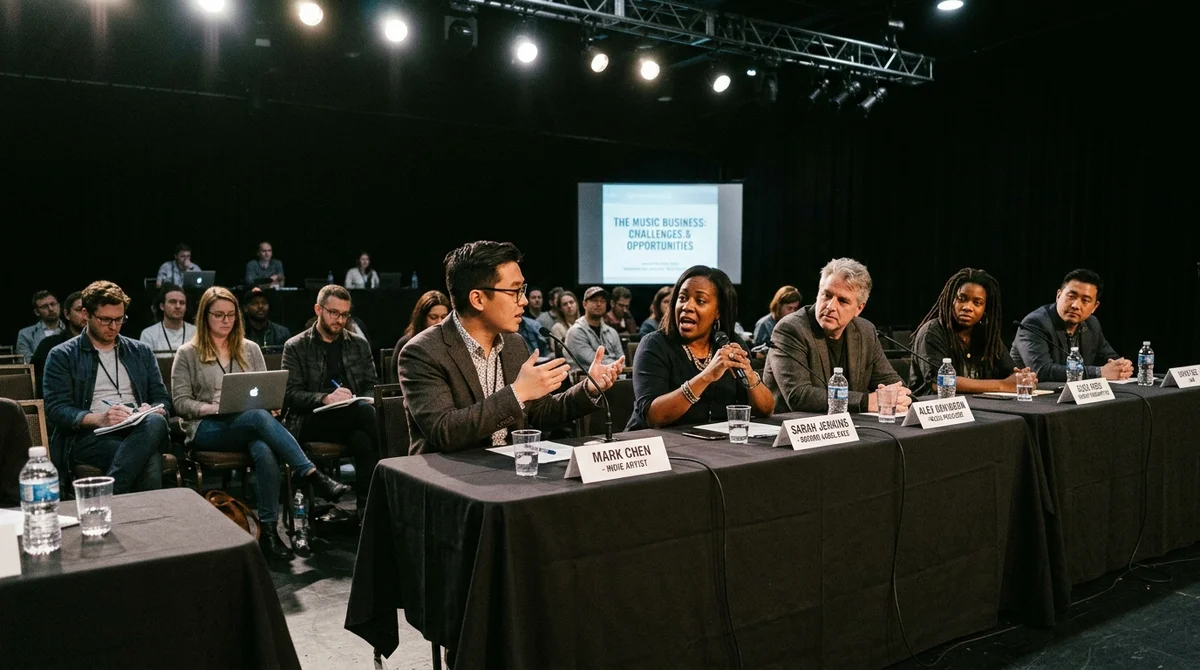
The music industry gathered in New York for Indie Week — and the conversation kept returning again and again to the same anxieties. Four problems dominated the agenda: generative AI, streaming fraud, unpaid authors and organizations that should protect them but fail to do so.
AI deals leave the indie sector behind
Major streaming platforms and AI companies are signing music licensing agreements directly with majors — bypassing independent artists and small labels. The indie sector feels excluded: deals are opaque, terms are not disclosed, and royalties, if they are provided at all, stay with the major players.
The key question is who has the right to give AI platforms permission to train models on someone else's music. While courts figure this out, labels take the money, and independent authors stand aside and watch.
Indie Week participants demand that any licensing deals with AI include explicit consent from every rights holder — not just the label's consent as a "bundled" representative.
Phantom streams hollow out the royalty pool
Streaming fraud is not new, but the scale is growing. Bots pump up billions of streams, diluting the royalty pool: the more fake streams, the less money real artists get per play.
- Spotify and other platforms have removed hundreds of millions of fraudulent streams in the past two years
- Some fraud is organized through professional schemes with paid manipulation services
- Detection tools are improving, but fraudsters adapt faster
- Small artists suffer more — their share of the pool is small, so the damage is noticeable
The industry is calling on platforms to provide greater transparency in royalty distribution algorithms and implement strict standards for stream verification.
Authors remain at the bottom of the food chain
Despite years of negotiations, songwriters earn less than performers even with the same number of streams. Statutory rates in the US are regulated by the Copyright Royalty Board, and the industry is bracing for another long round of rate negotiations for 2028-2032.
"Authors create the product that feeds the entire ecosystem.
Why do they get the smallest share?" — a typical comment from Indie Week panels.
A separate hot issue is ownership of tracks created with AI tools: who owns them — the human author who provided the prompt, the AI platform, or no one at all? No jurisdiction in the world has yet settled this question conclusively.
For authors actively using AI in their work, this creates legal uncertainty: they cannot register rights to works that involved an algorithm in their creation.
PRO organizations are falling behind the market
Performing Rights Organizations — ASCAP and BMI in the US, PRS in the UK — are responsible for collecting and distributing royalties to authors. But conference participants are increasingly saying these organizations are failing to keep pace with market changes.
Problems are mounting:
- Slow identification of rights amid massive volumes of uploaded content
- Lack of transparency in payment calculations
- Conflicts of interest between major publishers and independent authors within the organizations
- Lack of standardized rights databases compatible with AI platforms
Some participants propose creating a single global rights registry — but implementing such a project would require unprecedented cooperation among competitors who have fought each other for decades over market share.
What this means
The music industry finds itself at a point where old rules no longer work and new ones have yet to be written. AI accelerated the crisis, but did not create it — money has long been flowing in the wrong direction.
Whoever first proposes a systemic solution — transparent AI licenses, verified royalties, fair rates for authors — will gain a competitive advantage in an industry that is clearly looking for leaders.
Want to stop reading about AI and start using it?
AI News is a curated feed of AI/tech news. Hamidun Academy teaches you to use AI systematically in your work.