Isomorphic Labs научила AI находить скрытые карманы на белках для лекарств
Isomorphic Labs разработала IsoDDE — систему поиска мест на белках для крепления молекул лекарств. Компания привлекла $2.1 млрд и подписала контракты с Novartis
AI-processed from IEEE Spectrum AI; edited by Hamidun News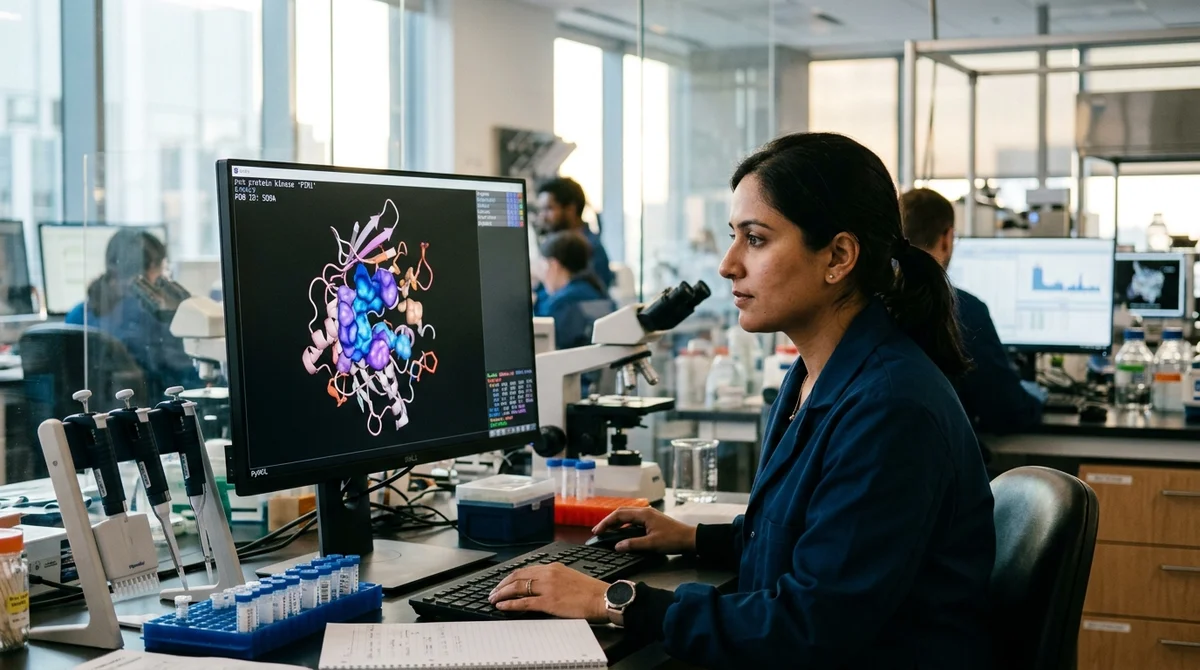
Artificial intelligence has promised to accelerate drug development for over a decade. But despite billions in investment, only a handful of AI-developed drugs reach patients. A Google DeepMind spinoff, Isomorphic Labs, may change this situation with its new IsoDDE system.
What AlphaFold Is Missing
AlphaFold2 and AlphaFold3 solved the main challenge — predicting protein structure. The first model even won a Nobel Prize. But proteins in living cells don't exist in a vacuum. They constantly interact with other molecules: nucleic acids, ligands, ions, other proteins. AlphaFold3 began modeling these interactions in a unified framework, but researchers noticed a problem. The further the system departs from training data, the worse its accuracy becomes. For drug design, this is critical: you need precisely new, unknown mechanisms of action — pockets on proteins that no one has ever seen before.
IsoDDE (Isomorphic Drug Design Engine) is a unified computational system that predicts not only protein structure but also identifies binding pockets, molecular affinity, and other properties.
Cryptic Pockets — The Perfect Key
Cryptic pockets are the most interesting part. These are regions on a protein surface that are not visible in its normal, unbound state. They only open when they contact a specific molecule. Think of them as a lock that needs the perfectly fitted key.
In January, Nature published an article about a previously unknown cryptic pocket on the cereblon protein — one of the most important proteins in targeted proteasomal degradation. This is the mechanism by which cells get rid of harmful proteins. IsoDDE not only found this pocket from just the protein sequence alone, but also accurately predicted how molecules bind in this unusual location. The system matched the crystal structure published in Nature.
From Small Molecules to an Entire Arsenal
Most modern drugs are small molecules — relatively simple compounds. IsoDDE works with different types of therapeutic molecules:
- Antibodies
- Peptides
- Molecular glues
- Small molecules
- Combined approaches
The company has already signed major partnerships with Novartis and Eli Lilly, raising $2.1 billion in Series B. IsoDDE's achievements are practical: the system finds targets that were previously considered inaccessible for drugs. There are many diseases where the associated protein is known but difficult to attack. This system makes such proteins manageable.
What This Means
AI finally approaches tasks that were previously inaccessible to it. Automating the fundamental part of drug design — the search for new targets and interaction mechanisms — is a turning point. Not just acceleration, but a qualitative shift in which diseases become targets for therapy at all.
Want to stop reading about AI and start using it?
AI News is a curated feed of AI/tech news. Hamidun Academy teaches you to use AI systematically in your work.