Shanghai Launches First Underwater Data Center Powered by Wind Energy
The world's first underwater data center, Shanghai Lingang, has begun operations off the Shanghai coast. A joint project of HiCloud Technology and…
AI-processed from Guardian; edited by Hamidun News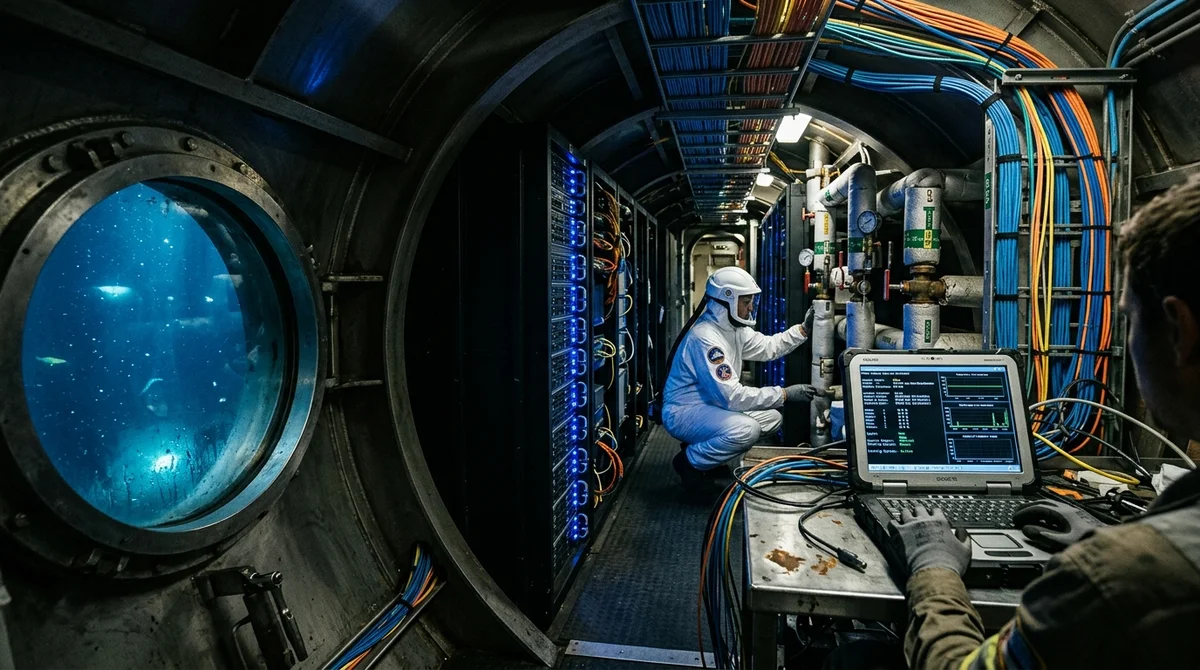
The world's first underwater data center powered by wind energy has begun operations off the Shanghai coast. This addresses one of the main problems of the AI boom: massive electricity and water consumption by servers.
How It Works
The Shanghai Lingang undersea data center project was launched in May this year. It was developed jointly by HiCloud Technology and state-owned China Communications Construction. The facility's capacity is 24 megawatts, equivalent to approximately 10,000 mid-range servers. The underwater installation is located 10 kilometers from the coast at a depth of about 300 meters.
Wind turbines on shore and on offshore platforms generate electricity, which is transmitted to the equipment via an underwater cable. Cold seawater serves as a natural coolant for processors and hard drives, which is much cheaper and more efficient than traditional air conditioning systems. Servers are housed in protected containers isolated from the marine environment. An automated control system regulates cooling, power supply, and monitors equipment status in real time.
Why Underwater Data Centers Are More Efficient
Traditional land-based data centers require significant energy just for cooling. On average, air conditioning systems consume 30-40% of the data center's total electricity. Underwater installations solve this problem through natural seawater cooling. Resource savings are substantial:
- 40% less freshwater for cooling—important for water-scarce regions
- 30-35% less electricity for maintaining optimal temperatures
- Occupies less land, critical for China's high population density
- Natural seawater cooling reduces capital expenditures on cooling systems
- Reduces the data center's carbon footprint through wind energy
China's Energy Crisis and AI Boom
China is facing a severe electricity shortage due to explosive growth in demand for AI computing power. Major tech companies and the government are investing billions in developing local AI models—from chatbots to computer vision systems, facial recognition, and autonomous driving. This requires countless servers running 24/7 without interruption.
The Chinese government is actively developing alternative energy sources (solar, wind, hydro) and seeking innovative solutions for data center placement. Underwater installations solve two problems at once: they save energy and don't compete for land with agriculture. Shanghai Lingang is a demonstration project, but its success could launch a wave of underwater investments along China's coast on the Pacific and Yellow Seas.
What This Means
Underwater data centers are no longer science fiction, but an engineering solution to a real problem at the scale of the AI boom. If Shanghai Lingang proves the model's viability, we can expect other countries to copy the idea. This is especially interesting for coastal regions with good wind generation—from Scandinavia and the UK to Southeast Asia and Australia.
For Russia, this could be a relevant solution in the context of Far Eastern seas and developing its own computing power for AI and local LLM models. While Shanghai Lingang proves the concept now, within 3-5 years such projects may become standard for energy-intensive data centers worldwide. This is not just a trend, but a necessity in the age of AI.
Want to stop reading about AI and start using it?
AI News is a curated feed of AI/tech news. Hamidun Academy teaches you to use AI systematically in your work.