Chi-kwan Chan Used Codex to Simulate Black Hole Behavior
Astrophysicist Chi-kwan Chan has applied OpenAI's Codex to create complex computer simulations of black holes. The AI assistant accelerated code development for
AI-processed from OpenAI Blog; edited by Hamidun News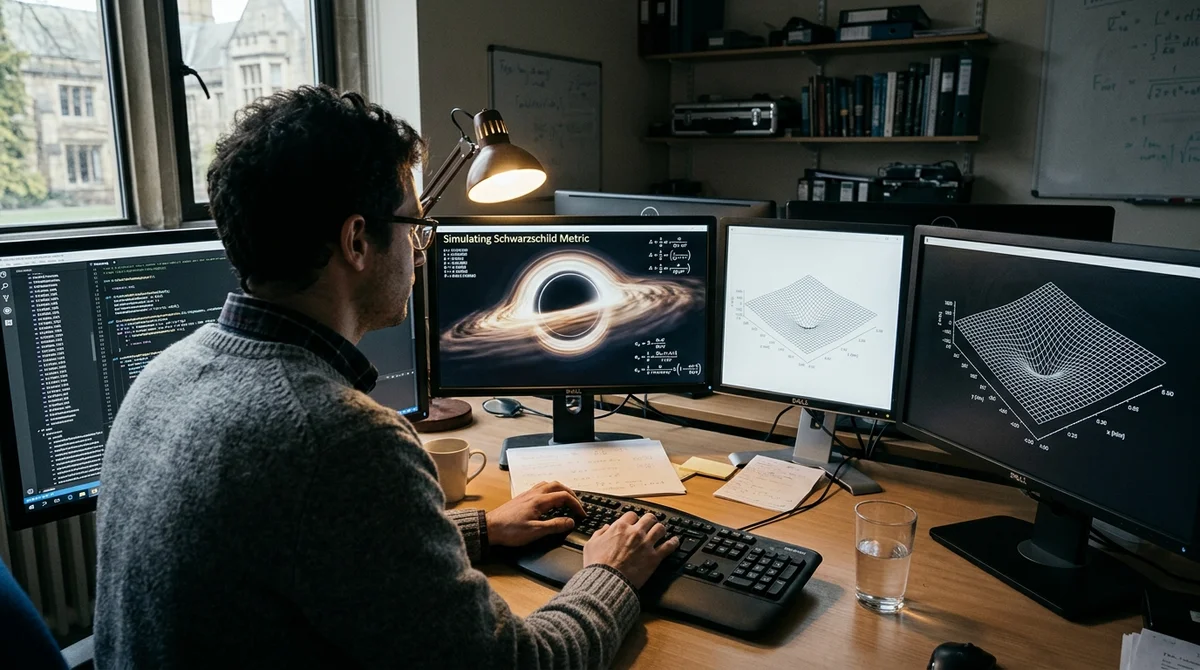
Astrophysicist Chi-kwan Chan from the University of Arizona used OpenAI's Codex language model to develop new computer simulations of black holes. This innovative approach allowed him to accelerate the writing of complex scientific code and create powerful tools for studying extreme phenomena in the universe.
When Classical Code Falls Short
Black hole simulation is one of the most complex tasks in modern astrophysics. Calculations involve solving massive systems of Einstein's general relativity equations, processing huge volumes of data, and optimizing it for supercomputers. Scientists typically write code in Fortran, C++, or Python, combining deep physics knowledge with programming expertise—a rare and valuable skill set.
Chan and his colleagues had faced the same problem for many years: each new algorithm required weeks of debugging and optimization. The code had to be not only physically correct but also maximally efficient when running on supercomputers. This required rewriting the same types of functions over and over again, wasting the researcher's precious time.
Codex as an Intelligent Physics Assistant
Codex is a deep language model trained on vast amounts of code from GitHub. The key advantage is that Codex understands the context of a task not only technically but also physically. When Chan described in a code comment that a specific differential equation needed to be solved for the Kerr metric (the mathematical description of a rotating black hole), Codex generated corresponding code blocks, saving hours of manual writing and debugging.
Capabilities that opened up for Chan:
- Rapid prototyping of numerical algorithms based on physical descriptions in natural language
- Generation of optimized code without needing to remember all syntactic details and library functions
- Accelerated debugging through Codex suggestions when type and logic errors appear
- Ability to focus on physics and science rather than technical programming details
Why These Simulations Matter
Computer models of black holes are not just beautiful visualizations for popular science. They are critically important for fundamental research. Using these simulations, scientists can test the predictions of general relativity under the most extreme conditions, where gravity is so powerful that it warps the very fabric of spacetime.
Develop data processing methods for observations using the Event Horizon Telescope—a unique instrument that photographed a black hole at the center of galaxy M87 for the first time in history.
Model collisions of black holes and the emission of gravitational waves that are detected by ground-based observatories like LIGO.
"Artificial intelligence allows us to focus on fundamental questions
of science rather than spend months debugging code."
What This Means for Science
Tools like Codex are becoming an integral part of the scientific toolkit of modern astrophysicists. AI accelerates not only code writing but the entire cycle of scientific research—from initial hypothesis to testing with real data. This could lead to faster progress in fundamental physics, new discoveries about the structure of black holes, and testing of gravitational theories that seemed impossible to verify experimentally.
Want to stop reading about AI and start using it?
AI News is a curated feed of AI/tech news. Hamidun Academy teaches you to use AI systematically in your work.