Waterloo Students Created an AI Sign Language Tutor in Futures Lab
University of Waterloo students developed an AI tutor that teaches sign language. This is part of Futures Lab—a program where young people create prototypes…
AI-processed from Google AI Blog; edited by Hamidun News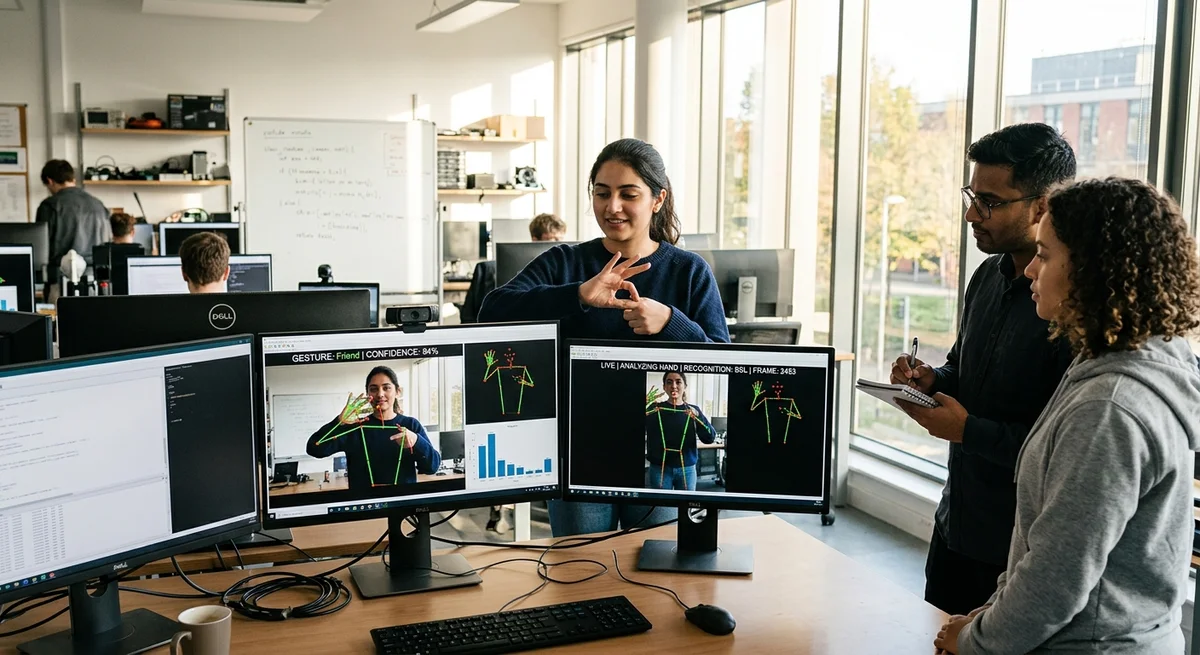
University of Waterloo launched Futures Lab—an incubator where students develop AI prototypes to reformat education and the job market.
What is Futures Lab?
This is an innovation laboratory supported by Google AI, where young developers create practical applications of artificial intelligence. In Futures Lab, students don't just learn technologies—they solve real problems in education, employment, and accessibility for people with different abilities. The laboratory operates on a principle of rapid iteration: idea → prototype → testing → improvement.
This gives students a rare opportunity to see how AI can be useful beyond lab work and academic projects. Each prototype is developed with the real needs of end users in mind. The laboratory's leadership is convinced that the best way to predict the future is to create it.
That's why Futures Lab focuses on giving students the tools, mentors, and freedom to experiment with ideas that could change people's lives.
AI Sign Language Tutor
One notable example is an AI system for teaching sign language. This solution addresses a real problem: people with hearing impairments often cannot find a qualified sign language instructor, which severely limits their educational and professional opportunities. The AI tutor uses computer vision to recognize the user's gestures, analyzes the accuracy of movements, and provides personalized feedback.
The system adapts to the student's level, allowing learning to accelerate. The main advantage: a person can learn at their own pace and at any time—without depending on an instructor's schedule or geography. This is not a replacement for a human teacher, but an assistant.
A student can practice at home, repeat complex gestures as many times as needed, and receive immediate feedback. In this way, AI expands access to education rather than limiting it.
Range of Projects in the Laboratory
Futures Lab works on more than just sign language tutors. Students experiment with different approaches to reformatting education and employment:
- Personalized learning systems that adapt to each student's learning style and pace
- Tools to support people with learning difficulties (dyslexia, dysgraphia, etc.)
- AI assistants for job preparation and interviews
- Systems to support retraining in conditions of automation and career transitions
All projects are united by one idea: to use AI to expand educational opportunities rather than replace people.
Why This Matters
The future of education is not created only in corporate laboratories of major tech companies. It's created in universities, when young people take a real problem and start solving it. Futures Lab shows that AI can become a tool for inclusivity and equitable access if developed with the needs of people with different abilities in mind. When students today create AI tutors and personalized learning systems, they are preparing tools for millions of people tomorrow. And this is not just an engineering success—it's a social impact that could transform the world of education.
Want to stop reading about AI and start using it?
AI News is a curated feed of AI/tech news. Hamidun Academy teaches you to use AI systematically in your work.