Hugging Face Enables TRL to Deliver Trillion Parameters Through Delta Weights
Hugging Face introduced Delta Weight Sync for TRL — a tool that delivers trillion parameters through Hub by sending only weight deltas. The method reduces…
AI-processed from Hugging Face Blog; edited by Hamidun News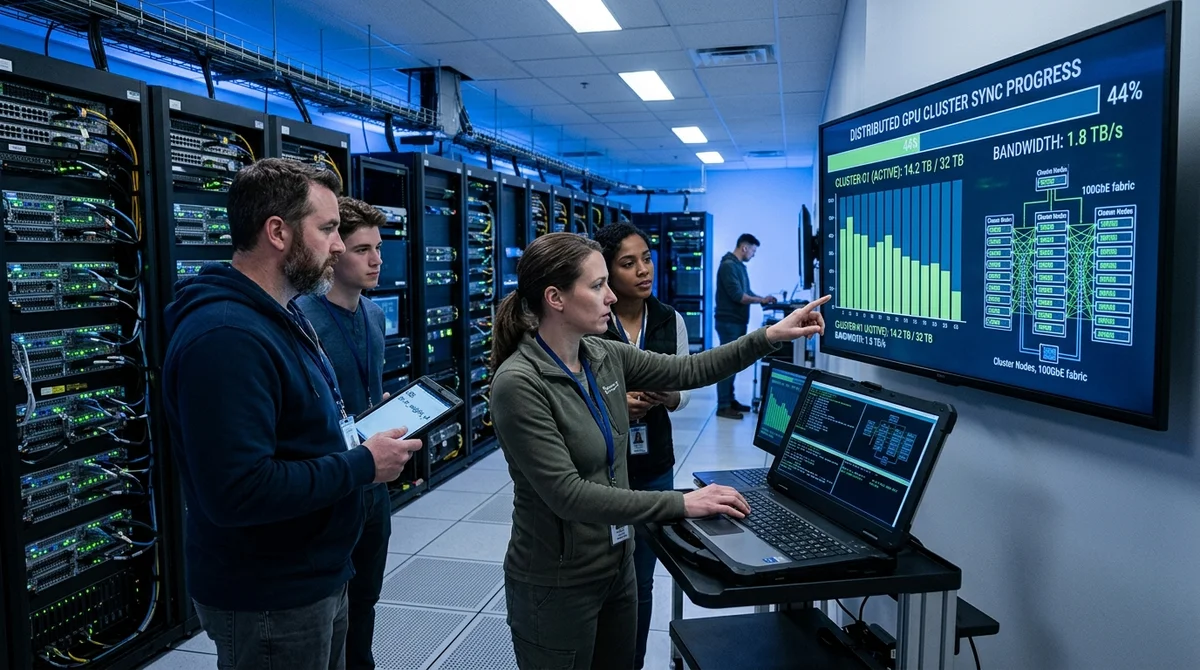
Hugging Face added Delta Weight Sync to the TRL (Transformers Reinforcement Learning) library — a method for efficient delivery and synchronization of giant models with trillion parameters through a standard Hub bucket.
Why Delivering Trillion Parameters Is Difficult
When training large language models in a distributed environment — for example, when fine-tuning through reinforcement learning or fine-tuning on specialized data — you need to synchronize model weights between cluster nodes. If a model weighs hundreds of gigabytes or even terabytes, simply sending full files means spending enormous amounts of network traffic. Traditional approach: download a full checkpoint (could be 2-4 TB), apply changes from one training step, upload back to Hub. On the Hub server, this takes up space (quotas), on the network — hours of waiting.
How Delta Weight Sync Works
Delta Weight Sync sends not the entire file, but only the difference (delta) between the old and new version of weights. It's similar to git diff, but for neural network weights.
- The difference between checkpoint A and checkpoint B is calculated
- Delta is compressed (compression achieves 10-50x on incremental updates)
- Delta is sent to Hub as a separate file
- On another node: delta is downloaded, applied to the local copy of weights
- Result: synchronization with data volume hundreds of times smaller
The effect depends on how much the weights changed. During incremental fine-tuning, often 2-5% of weights change, the rest matches the original. Delta Weight Sync actively leverages this.
Savings at Scale
For a trillion-parameter model, a full checkpoint can be 2-4 TB. Sending this volume over the network — that's hours, even on dedicated channels. A delta of 100-500 GB is sent in 15-60 minutes. For systems that synchronize weights dozens of times a day (typical for RLHF, where model weights change at each iteration), this saves days of training.
"With
Delta Weight Sync, you can keep giant models in Hub without the traffic penalty," — the concept underlying the tool.
Who Uses This
Delta Weight Sync is especially useful for:
- Distributed RLHF — when fine-tuning a model based on feedback from humans or other models
- Multi-node clusters, where each node in parallel fine-tunes its version of the model
- Hyperparameter experiments — quickly change configuration, synchronize only the delta
- Teams with limited bandwidth — cloud without unlimited bandwidth, local labs
What This Means
Delta Weight Sync is not a revolution in theory, but an engineering step toward practicality. Trillion parameters — no longer a nightmare for storage and synchronization, just a standard. For startups and research teams, this means: you can work with huge models on modest hardware and worse networks, if you properly organize delta compression.
Want to stop reading about AI and start using it?
AI News is a curated feed of AI/tech news. Hamidun Academy teaches you to use AI systematically in your work.