Mistral invests in Physics AI for industrial engineering
Mistral acquired Emmi AI and will focus on Physics AI — AI models for simulating physical processes in engineering. Focus on aerospace, automotive, semiconducto
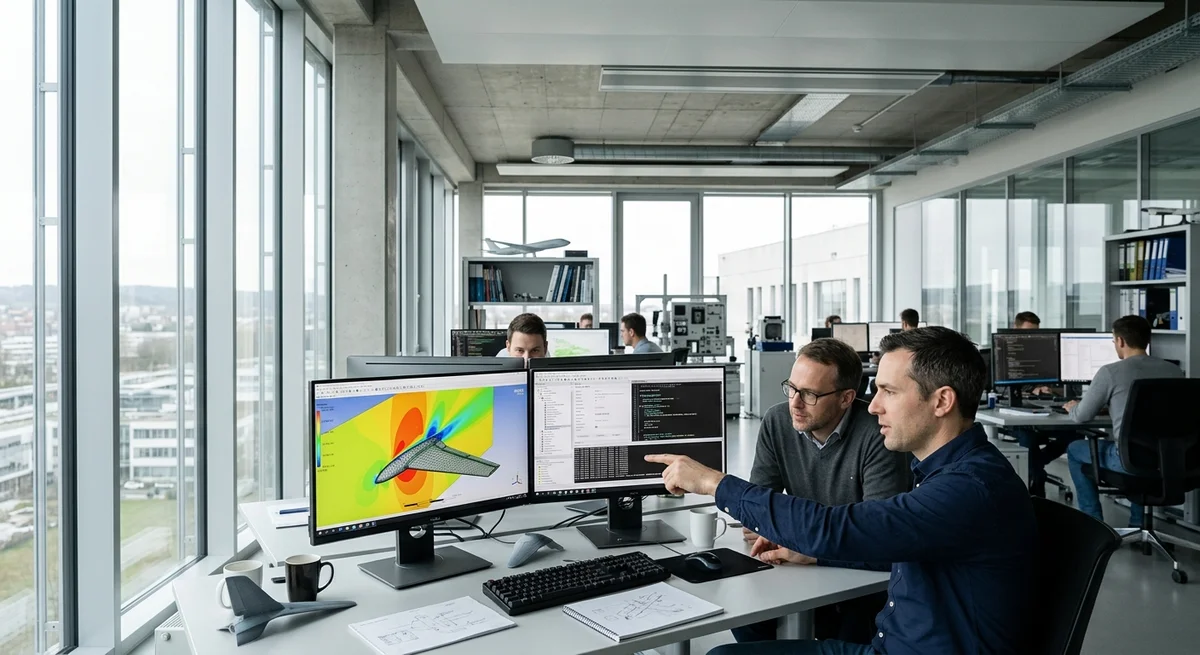
Mistral AI, one of the leaders in the open models industry, has acquired the Emmi AI startup and announced a priority development direction — Physics AI. This is not just another trend in neural networks: the company is deliberately building AI capable of modeling physical processes in real time for engineers, designers, and scientists.
What is Physics AI
Physics AI is a symbiosis of neural networks and engineering physics. Instead of running expensive numerical simulations on supercomputers for hours, engineers will be able to get results in minutes or seconds. For example, designing an aircraft wing and checking its aerodynamics in 3D, modeling plasma in a nuclear reactor, optimizing chip design — all with the help of trained neural surrogates. Classical CFD (Computational Fluid Dynamics) requires hours of machine time and is expensive. Physics AI promises to radically accelerate these calculations. Emmi's team has already done enormous work in this area and is now part of Mistral.
Technology Stack
Mistral opens access to its publications and datasets. The foundation of Physics AI in the company consists of several critical projects:
- Universal Physics Transformer (UPT) — a universal framework for training neural networks on physical tasks, works on regular grids and particles
- AB-UPT — specialization of UPT for aerodynamics CFD, processes huge 3D models (140 million volume cells on a single GPU without repartitioning)
- NeuralDEM — the first end-to-end surrogate for multiphysics processes, applied in fluidized bed reactors
- GyroSwin — an architecture for simulating plasma turbulence, critical for designing thermonuclear reactors
- Fluid Intelligence — research linking machine learning methods with the CFD community
All research is open: arXiv contains preprints, GitHub — code and datasets. This strategy helps Mistral attract engineers and scientists.
Who Needs This
Physics AI is targeted at sectors that define the physical world: aerospace (satellites, aircraft, rockets), automotive (engines, safety systems), semiconductors (design and manufacturing) and energy (wind, nuclear, solar). Each sector is measured in trillions of dollars. Even 5-10% acceleration of calculations means hundreds of millions in savings. If an engineer tests not two, but one hundred design variations in a day, quality jumps dramatically.
What This Means
Mistral positions itself not as a supplier of universal models, but as an architect of AI infrastructure for specialized engineering. This reflects a trend: general LLMs are insufficient for professional tasks with high stakes. Neural networks trained on the physics of a specific industry are needed, with open code and transparency.