Reachy Mini Learns to Speak Locally Without the Cloud
The Reachy Mini robot can now talk completely locally. The entire stack—VAD, STT, LLM, TTS—runs without cloud or API. Users choose models themselves, with no…
AI-processed from Hugging Face Blog; edited by Hamidun News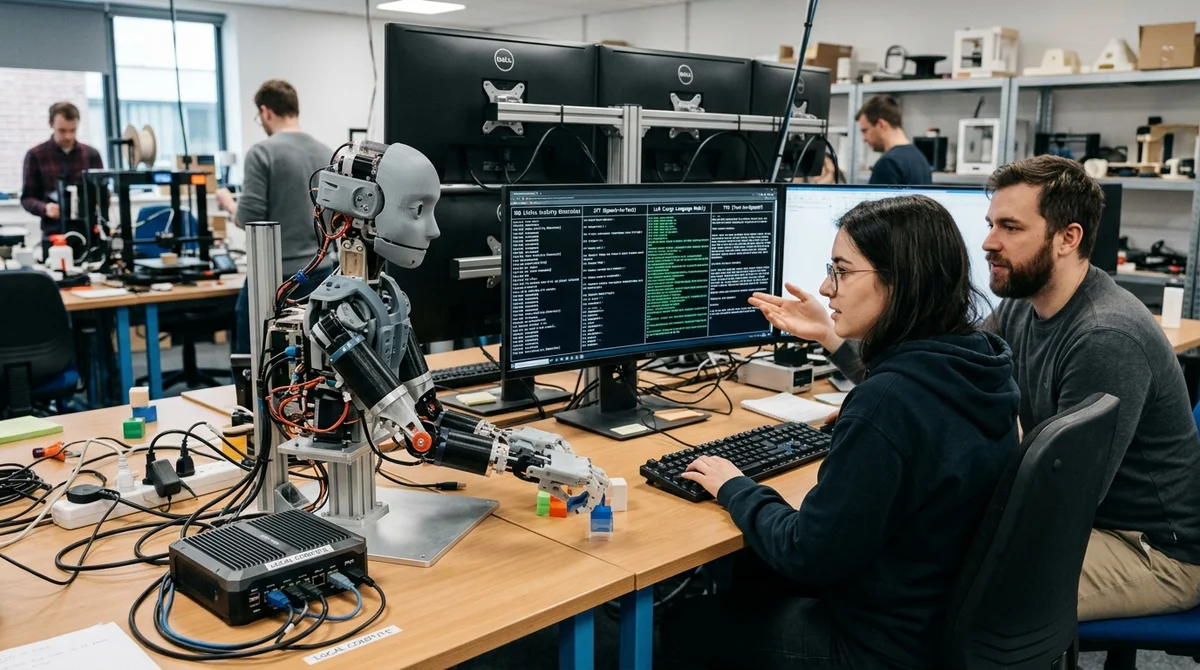
The Reachy Mini humanoid robot from Pollen Robotics can now operate completely locally. The entire speech recognition stack—from voice to response—runs on the local device without sending data to the cloud. This is the first complete example of how an AI robot can be fully independent from cloud services.
How Exactly the Local Stack Works
Reachy Mini uses a cascading pipeline where each component passes its result to the next on the local device. A person speaks—Voice Activity Detection (VAD) detects the speech, Speech-to-Text (STT) converts it to text, the LLM processes the text and generates a response, then Text-to-Speech (TTS) speaks the result.
Hugging Face provided a ready-made example with open components and a WebSocket API compatible with the Realtime API standard so developers can start using it immediately. Setup requires a minimum: install a local LLM via llama.cpp, mlx (for Apple Silicon), or another framework, then launch the speech-to-speech library. This takes just a few terminal commands. The robot connects to the local backend through the app's UI.
What Components Make Up the Stack
The local stack consists of four modules, each of which can be replaced:
- Voice Activity Detection (VAD) — Silero VAD v5 accurately detects when a person starts and stops speaking, ignoring background noise
- Speech-to-Text (STT) — Parakeet-TDT 0.6B v3 converts speech to text with minimal latency
- Language Model (LLM) — Gemma, Llama, or any other model of choice, can be local or on a remote server
- Text-to-Speech (TTS) — Qwen3-TTS voices the robot's response in real time
Developers can replace any component. For example, if support for a specific language is needed, find the best STT model for that language. If the task requires maximum response speed, optimize VAD and LLM for low latency.
Why This Matters for Developers and Companies
Previously, an AI robot was tied to a cloud provider: you use whatever model OpenAI or Google uses, pay by the minute, and your data goes to corporate servers. Now that constraint is gone.
The local stack solves three key problems simultaneously. First, privacy: audio streams and text never leave the local network—critical for production scenarios, healthcare, and corporate environments. Second, economics: no cloud API costs, which can be substantial during long sessions. Third, full control: users choose models and can change them without being locked to a cloud provider.
"Cascades are the most flexible option in the open-source ecosystem today," write the authors in a
Hugging Face post, emphasizing that components easily combine and swap out.
What This Means for the Future of Robotics
This is an important step toward democratizing AI robotics. Humanoid robots are becoming not just cloud services with mechanics, but full-fledged independent systems that anyone can customize for their needs. Researchers can now focus on algorithms and integration rather than cloud infrastructure.
Want to stop reading about AI and start using it?
AI News is a curated feed of AI/tech news. Hamidun Academy teaches you to use AI systematically in your work.