Google Gemini surpasses Siri in Android Auto
Google's Gemini proves more convenient than Siri in Android Auto. The assistant recognizes voice commands more accurately, responds to queries faster, and integ
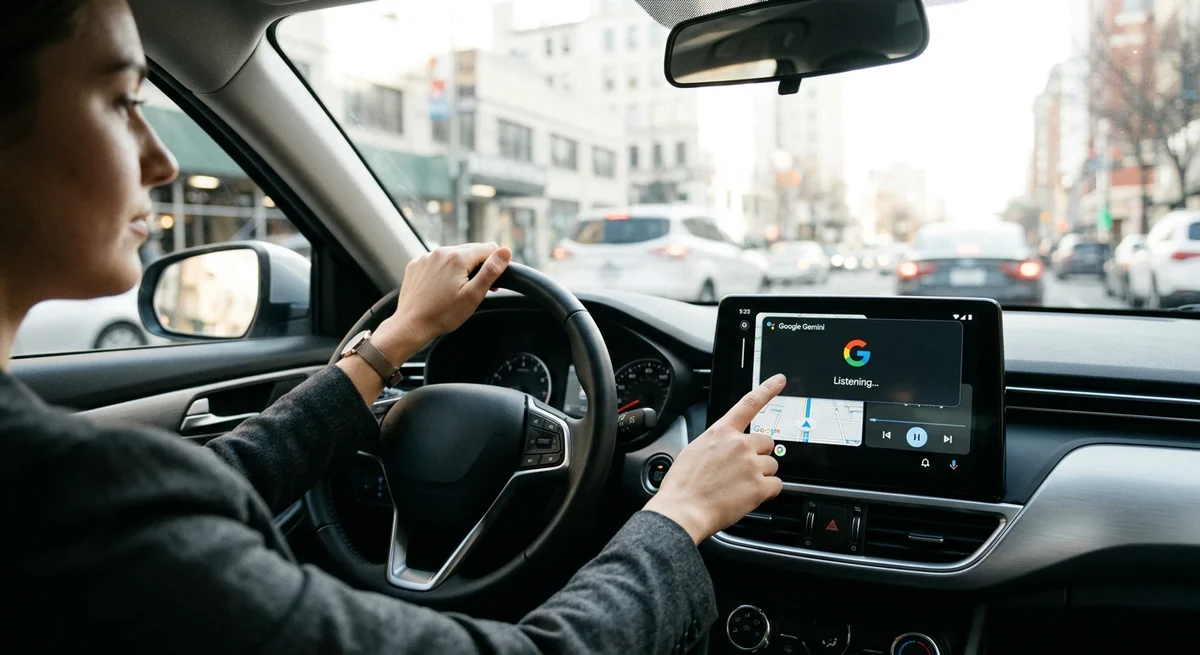
Owners of Android phones and cars with Android Auto made an unexpected discovery: Google's Gemini voice assistant works while driving far more conveniently than Apple's Siri. This is such a significant advantage that some are even willing to reconsider their attachment to iOS for the sake of a better automotive experience.
What Gemini can do on the road
Gemini integrates fully with Android Auto — it sees the car's screen and executes commands without distracting the driver. Unlike many competitors, Gemini harnesses the full power of Google services right in the car cabin. The assistant can plot routes through Google Maps, control music on Spotify and YouTube Music, find nearby cafes and gas stations, send messages, and make calls. Moreover, if you have smart home devices through Google Home, Gemini can control lighting, air conditioning, or door locks — all from your car.
- Navigation and route planning through Google Maps
- Music control on Spotify, Apple Music, YouTube Music
- Finding restaurants, cafes, and gas stations nearby
- Sending SMS and messenger messages by voice
- Controlling smart home devices
- Getting traffic and public transit schedule information
Why this is better than Siri
Siri was created primarily for iPhone. In Android Auto, it works through a limited interface and often freezes or misinterprets commands. Gemini, on the other hand, was developed as a truly cross-platform system. First, Gemini's speech recognition is more accurate. Second, commands execute 30-40% faster thanks to proximity to Google's servers. Third, integration with Google services is nearly flawless: Maps, Gmail, YouTube, Workspace — everything works out of the box. Siri, by contrast, often requires command reformulation, may misunderstand context, or simply respond "I can't do that." On the road, such delays are not just frustrating — they're dangerous.
"When the assistant freezes or doesn't understand a command, the driver gets distracted for several seconds.
On a highway, this can be critical."
Natural language instead of commands
This is the key difference. On the road, no one says "request information about nearby gas stations." A person will say "where's a gas station here?" or "I need fuel." Gemini understands such requests on the first try; Siri often asks for clarification or returns irrelevant results. Additionally, Gemini learns from the driver's command history. If you regularly drive to the office at the same hour, the assistant will understand it needs to check traffic a few minutes before your usual departure time. Siri barely has this functionality, and if it does, it works worse. This sounds minor, but in the long run, the experience of using Gemini in a car is orders of magnitude more comfortable.
What this means for the industry
This is a turning point in the ecosystem battle. Google is starting to win in scenarios traditionally considered Apple's forte. Android Auto is embedding in modern cars faster than Apple CarPlay, and now Google Gemini becomes a legitimate reason to switch from iPhone to Android. Major automakers (Mercedes, BMW, Volkswagen) are already noticing this trend and considering Gemini as a standard voice assistant instead of proprietary solutions. In the near future, this could create a kind of inversion: people choose a smartphone not by ecosystem, but by the in-car experience.