PerPlant raises €1M for AI cameras enabling precision field spraying
PerPlant raised €1 million in funding to develop an AI-powered precision spraying system. The camera mounts on a tractor roof, analyzes crops in real-time, and
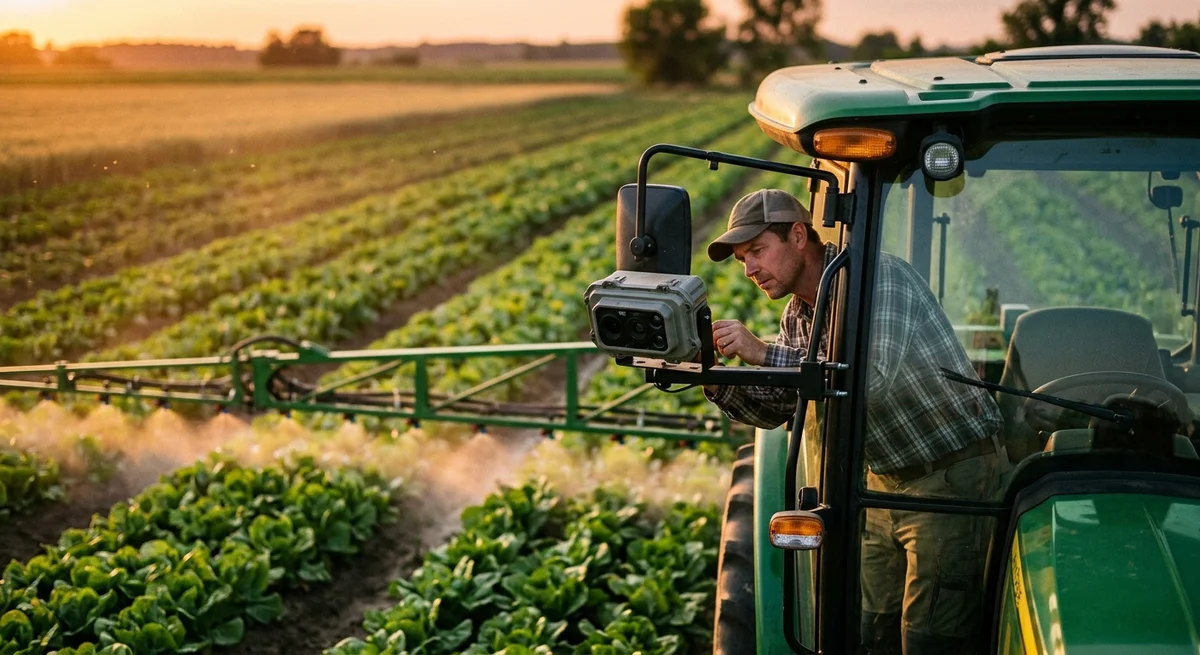
Danish startup PerPlant received €1 million in investments from Scandinavian funds to expand its AI camera system that helps farmers spray fields with surgical precision. The solution is straightforward: a box with a camera on the roof of a tractor looks at plants, a neural network decides where treatment is needed, and the tractor activates nozzles only in the necessary places.
How precision spraying works
The traditional approach still dominates fields: spray the entire field indiscriminately. This is cheap in terms of logistics — one pass and it's done. But costly in terms of the budget: some chemicals land on healthy plants, some is lost, some settles outside the target zone and contaminates the soil around the field. PerPlant offered an alternative: a camera sees each plot in real time, AI analyzes the state of the crops and determines whether treatment is actually needed at that location, and the system performs it precisely — only where required. The result is twofold: the farmer pays less for chemicals, and the environment absorbs fewer pesticides.
The key feature is that the system works entirely on the tractor's onboard computer. Cloud and internet are not required. This is critical because in rural areas the signal is unstable, and a farmer cannot wait for a cloud response in real time. The savings are substantial: users report a reduction in costs of 30–40 percent while maintaining or even improving yields.
200 thousand hectares, 9 times more drones
PerPlant has already mapped 200 thousand hectares of agricultural land across Europe. This is striking in its scale: all Danish agricultural drones combined cover only 22 thousand hectares. In other words, PerPlant achieved nine times greater coverage in just a few years — using ground machines that are cheaper to maintain than aircraft. This scale was achieved through radical simplicity of integration. The system works with popular tractor models: John Deere, CLAAS, Case IH and others. A farmer simply mounts the box on top of the cabin, calibrates the camera in half an hour, and in the first season already feels the savings. There is no need to retrain or change the fleet of equipment — everything is compatible.
Partnerships with large cooperatives helped PerPlant quickly take a niche in the European market. Cooperatives often act as agents: purchasing systems for their members in bulk and assisting with installation. This reduces friction for mid-size farmers.
Scandinavia looks at the USA
The investors who participated in the Series A round are two prominent Scandinavian funds. Both are openly concerned about expansion into the American market. American farmers consume huge volumes of pesticides and fertilizers: the precision agriculture market in the USA is valued at several billion dollars annually. For PerPlant this is a green light — the technology is universal, American tractors use the same standards.
There is competition in the market: American startups like Carbon Robotics and See & Spray already work in the niche. But PerPlant wins on simplicity and cost of entry. The system does not require re-equipping the entire fleet of machinery, works with any modern tractors, and the cost of ownership remains at the level of modest capital investments for a large farm. This works in PerPlant's favor against more complex and expensive alternatives.
What it means
Precision agriculture is finally emerging from laboratories into real farm fields — and the investments confirm this. For farmers it means a real reduction in costs by tens of percent through optimization of treatment. For the climate — significantly less chemicals into the soil and groundwater.
And for investors — it is a signal that startups which automate routine and costly tasks in the agricultural sector are becoming among the most effective. If PerPlant can replicate its European success in the USA, then dozens more startups with AI solutions for agriculture will follow: harvesting automation, yield forecasting, crop rotation optimization. The entire agricultural sector will eventually become digital and automated.