Swiss startup creates four-armed robot for space stations
Swiss startup Orbit Robotics unveiled Helios — a four-armed robot for work inside space stations. In microgravity conditions, two front arms anchor to the struc
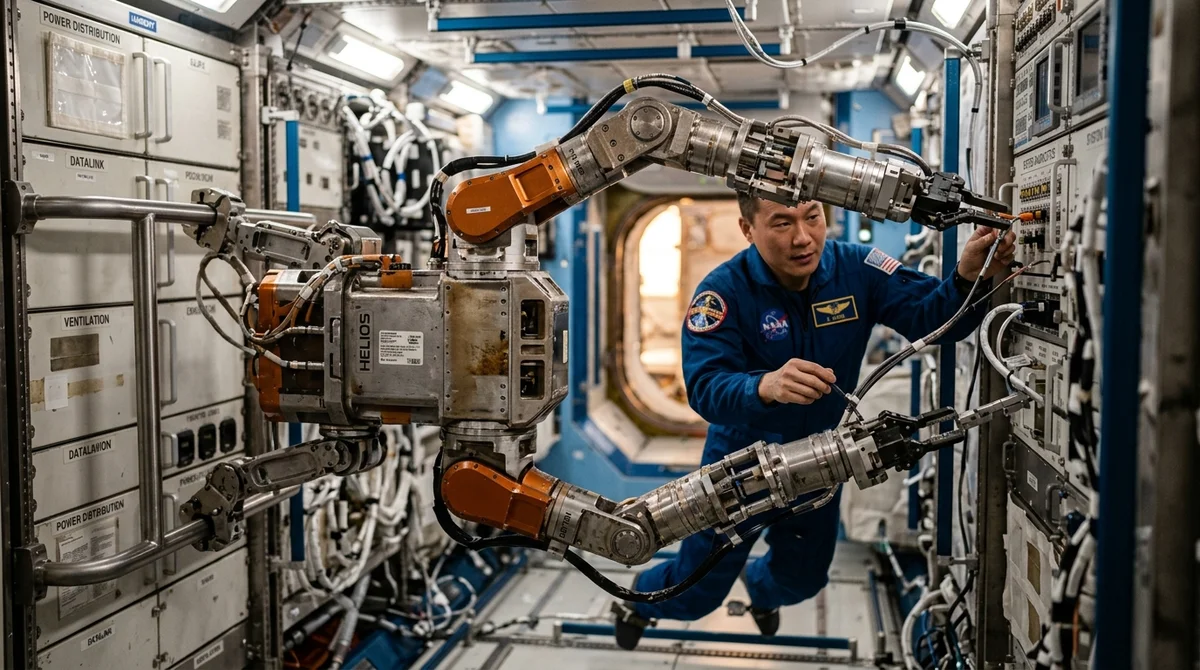
Swiss startup Orbit Robotics presented Helios — a robot with four arms for working inside space stations. In microgravity conditions, classic bipedal design simply doesn't work. Engineers chose an unusual but logical approach that could become the standard for orbital robotics.
Four Arms Against Zero Gravity
Cosmonauts work in bulky spacesuits, tethered to the station with cables and safety lines. Legs don't help in microgravity — there's nothing to push against, and nowhere to anchor. The Helios robot solves this problem differently: two front arms anchor to handrails and panels inside the station, while two rear arms remain free for the main work. The design is logical from an engineering perspective. Anchoring and task execution happen simultaneously. No unnecessary legs that take up space in narrow corridors and add weight during delivery to orbit. Each kilogram of cargo on the ISS costs thousands of dollars in transportation. This approach allows the robot to:
- Hold itself in zero gravity without additional anchoring mechanisms
- Perform maintenance tasks simultaneously with two working arms
- Work in narrow corridors, sealed modules, and problem compartments
- Not require retrofitting existing station structures
Helios can be equipped with different tools depending on the task — from monitoring sensors and video cameras to welding modules and mechanical grippers.
The Economics of an Hour in Space
The numbers are impressive. Each hour of an astronaut's work on the ISS costs approximately $140,000. This cost includes astronaut training (monthly preparations), rocket delivery, medical insurance, and compensation for health risks. A robot that takes on routine or dangerous operations directly reduces these expenses. Helios can handle equipment diagnostics, system maintenance, component repairs, and cargo organization. If the robot saves even 20 hours per year, the cost of its development and delivery will pay for itself within several seasons. For next-generation commercial space stations, this could be a decisive competitiveness factor.
"Helios is the first step toward roboticizing the internal space of
stations," the developers explained in the announcement.
What Needs to Be Proven
Helios faces a harsh testing ground. Microgravity, extreme temperature fluctuations from -70 to +120 degrees Celsius, cosmic radiation — all of this will test the machine's reliability. When the robot reaches the ISS or a commercial station, it will have to work in dangerous zones: repairing solar panels, in low-pressure compartments, working with substances hazardous to humans. The first months of operation will show whether Helios is ready for everyday tasks or requires further refinement.
What This Means
Automation in space is scaling up. If Helios proves its reliability, orbit will be inhabited by an entire fleet of specialized robots — assistants that work around the clock without days off and don't require enormous costs for delivery there and back. This could change the economics of orbital projects for decades to come and open the path to cheap, 100% automated scientific and industrial activity in orbit.