AI Recovers Voices of Deceased Pilots from Spectrograms — NTSB Restricts Access
Researchers used artificial intelligence to recover pilots' voices from spectrograms of aircraft black box visual recordings. The system successfully recovered
AI-processed from TechCrunch; edited by Hamidun News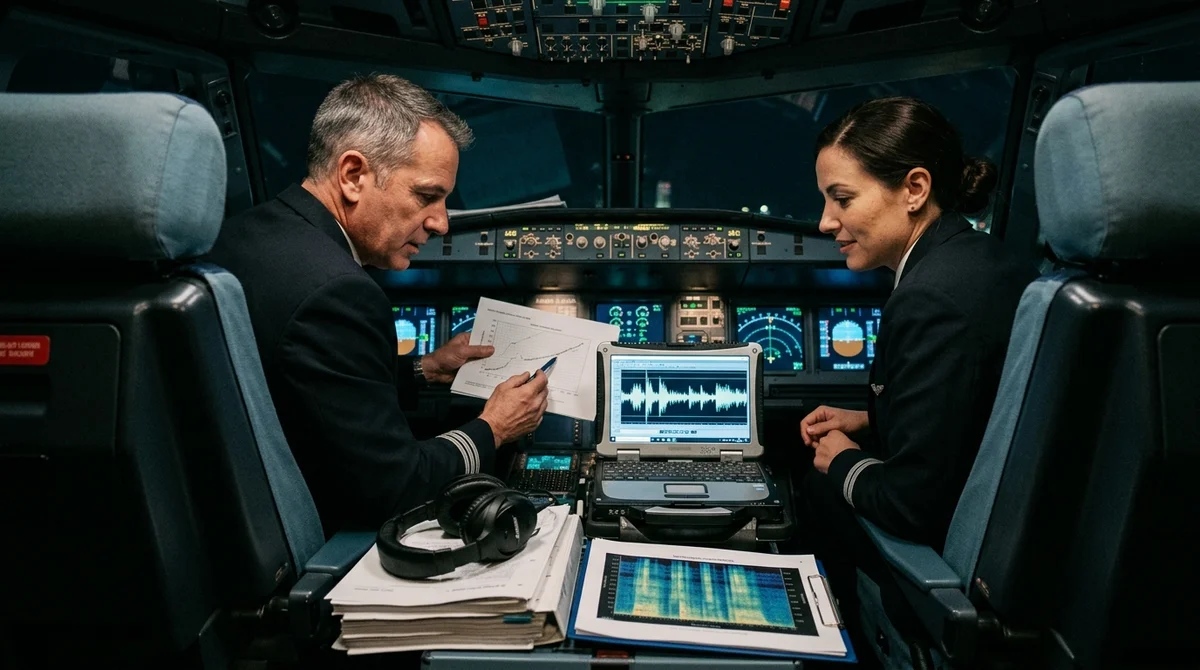
Researchers demonstrated that artificial intelligence can recover human voices from spectrograms of aircraft black box recordings. This discovery prompted the US National Transportation Safety Board (NTSB) to temporarily close access to its crash database and reconsider its confidentiality policies.
How to Recover Voice from an Image
A spectrogram is a visual representation of sound: a two-dimensional graph where the X-axis represents time, the Y-axis represents the frequency of sound oscillations, and color indicates intensity. To the eye, these are swirls and bands, often resembling abstract art. But in reality, it's complete information about an audio signal encoded in graphical form.
Black box recordings (cockpit voice recorder, CVR) contain audio recordings from the flight deck microphones. These recordings are manually transcribed and published as spectrograms in NTSB reports — specialists read the graphs to understand the sequence of events before the crash.
Researchers used deep neural networks for reverse transformation: they trained AI to convert spectrograms back into sound. This became possible due to advances in deep learning methods (diffusion models, transformers) and the availability of large training datasets.
The process works roughly as follows:
- AI is trained on thousands of pairs: spectrogram + original audio
- The neural network learns patterns between the visual and audio signal
- When fed a new spectrogram, it reproduces the original sound
- Quality depends on the resolution of the spectrogram and the complexity of the acoustic environment
Why NTSB Was Alarmed
The NTSB publishes spectrograms in open accident reports to ensure transparency. This allows scientists, journalists, and engineers to analyze incidents. But these spectrograms contain the final minutes of the crew's lives — their voices, conversations, sometimes final words before the disaster.
Pilots never consented to having their voices published and potentially recovered. For many years, the spectrogram seemed safe from a privacy standpoint: an ordinary person could not extract voice from such a graph. But new AI technologies showed that this protection was an illusion.
'The technology made it possible to recover voices with sufficient
clarity to hear individual phrases and intonation,' — roughly how the NTSB reacted.
Agency Response and Search for Solutions
The NTSB closed access to its docket system, which stores thousands of reports, spectrograms, and accident materials. This is an unprecedented step — the agency is reconsidering how to balance investigation transparency with family privacy.
Possible options:
- Completely remove spectrograms from public reports
- Encrypt or obfuscate spectrograms to prevent AI recovery
- Keep them with explicit warnings about recovery possibility
- Require family consent before publishing materials with voices
- Publish edited versions with filters that distort voice without losing information
What This Means
This symbolizes the conflict of our era: technology develops faster than society and regulation. What seemed safe due to access complexity now becomes accessible with a button click. For the aviation industry, it means new privacy standards accounting for AI capabilities are needed. For society as a whole, it's a reminder that neural networks can extract information from sources we considered protected. This requires a reassessment of what should be considered confidential in the age of powerful artificial intelligence.
Want to stop reading about AI and start using it?
AI News is a curated feed of AI/tech news. Hamidun Academy teaches you to use AI systematically in your work.