Hand Instead of Screen: How Wetour Robotics Reinvented Interfaces
Wetour Robotics has abandoned traditional interfaces. Their Orchestra system simultaneously processes three streams: where the body is located, where the…
AI-processed from IEEE Spectrum AI; edited by Hamidun News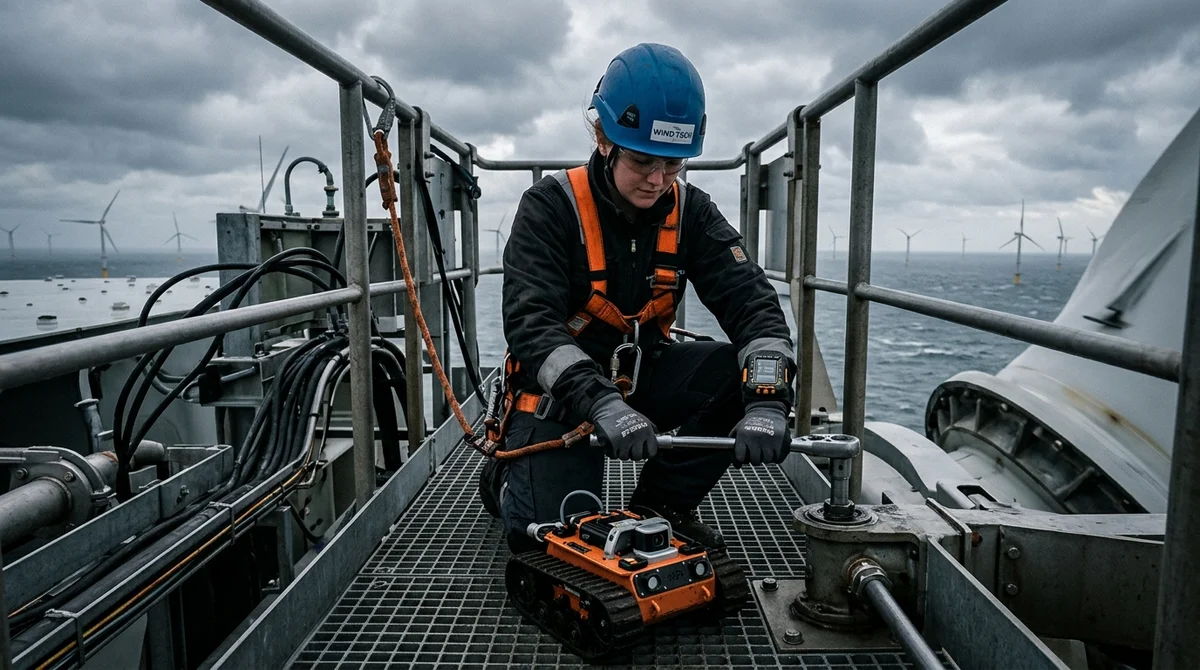
An asymmetry has emerged in Physical AI. Robots jump, dance, and handle fragile objects, but controlling them still requires screens, buttons, or voice—methods that have remained unchanged for 40 years. Wetour Robotics solved the problem from a different angle. Instead of making robots even smarter, the company redesigned the interface between human and machine.
Why Screens and Voice Don't Work
Over three years, Physical AI has made incredible progress on the robot side. Boston Dynamics, Figure, and Unitree have developed actuators and manipulator dexterity at a level that seemed impossible a decade ago. Google DeepMind demonstrated that vision-language-action models work in unstructured environments. But progress stalled at interfaces. For forty years, computers have waited for a person to stop, look down, and translate their intention into a command. On a wind turbine, on a loading dock, or on a busy street, this approach silently collapses. A technician cannot let go of the key. A worker cannot look at a screen. A pedestrian cannot loudly speak commands. The bottleneck has shifted from the machine side to the human side.
Spatial Intent Fusion: Three Streams Instead of One
Wetour Robotics called their approach Spatial Intent Fusion—simultaneous processing of three streams of information about a person:
- Body position in space
- Gaze direction and visual context
- Muscle signals through electromyographic sensors
- Processing speed under 100 milliseconds
- Intention prediction 50–80 ms before visible movement
Each channel in isolation is ambiguous. But together, processed at the operating system level with very low latency, they paint an unambiguous portrait of what you're about to do.
How It Works: Layers and Engines of Orchestra
Orchestra is a portable computing hub with three perceptual layers. VisionLink processes video: cameras track objects, distances, and context. Conductor reads biosignals from a wearable bracelet with surface electromyographic sensors (sEMG). Orchestra OS fuses these streams in four engines: sensor perception, intention inference, command orchestration, and safety checks. The key trick: motor unit action potentials appear on the skin 50–80 milliseconds before the finger completes a gesture. The system predicts what you're about to do before you do it. Everything runs on edge—on the local device, without the cloud. NVIDIA Jetson Orin Nano Super provides enough inference to close the control loop in 100 milliseconds.
"Your body is the interface," —
Wetour Robotics' slogan that conceals a complex architecture of computer vision, biosignal processing, and real-time intent inference.
What It Means
The history of computing is a history of interface revolutions. The command line displaced the punch tape, the graphical interface displaced the command line, the touchscreen displaced buttons, and voice displaced the touchscreen. Each transition expanded who could participate in the system and what they could do with it.
The next transition is not a new screen and not a new microphone. It's the human body as a first-class node in a computing network, with the speed and precision of any other connected device. This doesn't compete with the development of humanoids and foundation models—it's a complement.
Humanoids need training data. When people become first-class nodes in the loop, every interaction they have with the world becomes a potential signal for the next generation of Physical AI.
Want to stop reading about AI and start using it?
AI News is a curated feed of AI/tech news. Hamidun Academy teaches you to use AI systematically in your work.