Augustine and GAN: Why the Battle of Good and Evil is an Adversarial Network
A philosopher and mathematician unified Augustine's idea—that evil is the absence of good—with GAN (Generative Adversarial Network) architecture. Using Bosch's
AI-processed from Habr AI; edited by Hamidun News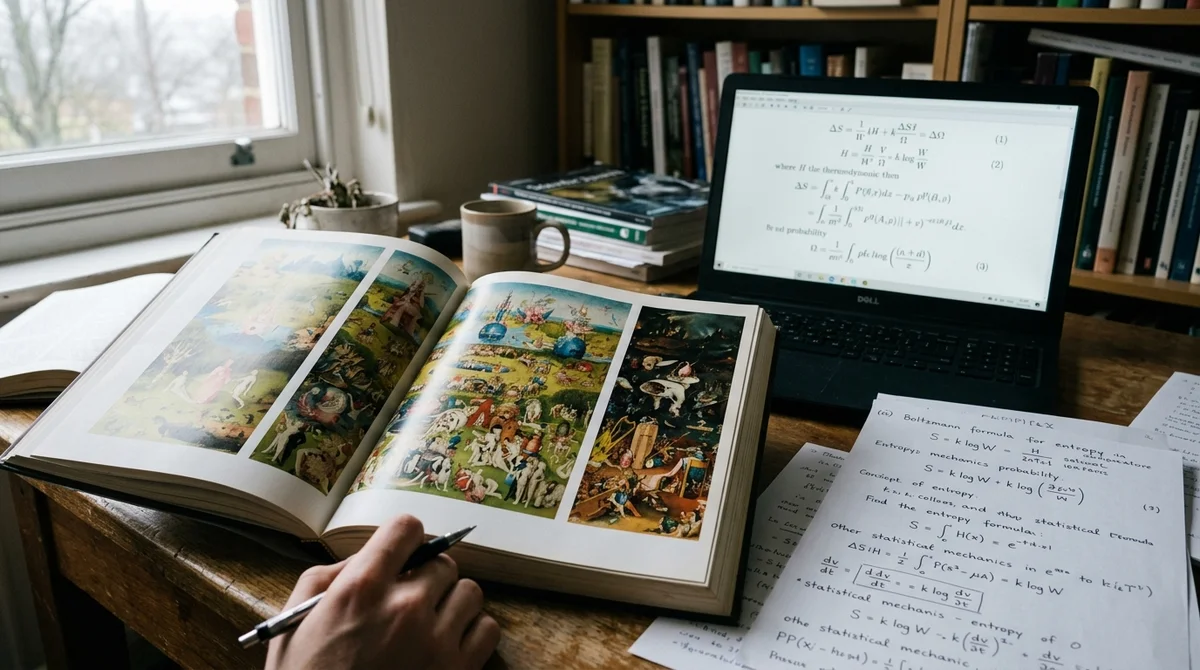
A philosopher and mathematician met in Hieronymus Bosch's triptych. The painting "The Garden of Earthly Delights" is not merely a masterpiece of art, but a visual expression of Saint Augustine's philosophy: the idea that evil is not an active force, but the absence of good, a void, a loss of choice.
Bosch vs. Augustine = GAN
The triptych unfolds the story in three acts. On the left is Paradise (harmony between reality and freedom). In the center are earthly pleasures (permissiveness). On the right is Hell (collapse of diversity, where everything collapses into a single point). This is not moralizing, but a mathematical description of the dynamics of choice.
Augustine said that a person does not sin because they 'do evil' — they sin because they stop 'doing good.' Entropy decreases. In this logic, a generative adversarial network (GAN) operates on the same principle: the generator creates diversity, the critic constrains it. Balance between them is freedom. The critic's dominance is Hell.
Three States of Entropy
The model shows:
- Paradise — maximum entropy of choice. Balance between possibilities and freedom to act. A person moves, learns, discovers new things.
- Hell — minimum entropy. Dominance of critic, fear, punishment. Diversity dies. All points collapse into a single heap.
- Chaos — permissiveness without foundation. Freedom becomes meaningless noise. No structure, only randomness.
These are not three places in the afterlife. These are three modes of operation of a single system — whether it's a human, an organization, or a neural network.
Sin as Mathematics
If we take entropy S as a measure of vital space, then sin is expressed as ΔS — a decrease in entropy. It seems contradictory: we speak of 'sinfulness,' but science counts the loss of order. But that's precisely the point: sin is not an increase in chaos, but a narrowing of the world, a loss of horizons, a collapse into a point.
Freedom is not the absence of rules. It is a space for thinking, for choosing, for creating meaning. Rules are necessary. But when they become everything, only obedience remains.
What This Means
Old philosophical ideas don't lose their meaning in the era of algorithms — they become more precise. Bosch's triptych describes the dynamics of any system: human consciousness, society, neural networks. Augustine helps us understand GAN architecture. And mathematics provides a tool to measure what was previously accessible only to art and philosophy.
Want to stop reading about AI and start using it?
AI News is a curated feed of AI/tech news. Hamidun Academy teaches you to use AI systematically in your work.